TL;DR: No
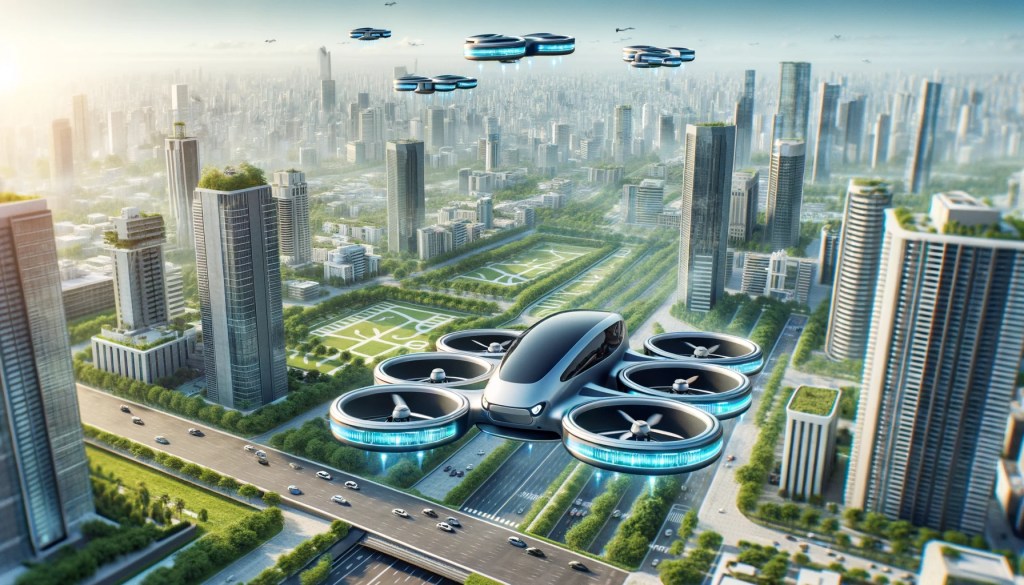
In a recent episode of Derek Thompson’s Plain English, I encountered a new term: distributed energy propulsion (DEP). It’s the technology behind electric vertical takeoff and landing (VTOL) vehicles aka flying cars. It seems the future is getting closer.
a new era of propulsion
Distributed energy propulsion is the brainchild of a relentless quest to break free from the chains of traditional propulsion systems. Instead of relying on a single, central engine, DEP uses multiple smaller engines distributed across a vehicle’s structure. It’s how a school of fish maneuvers through water, each fish playing a part in the collective motion.
From the Ground Up
The history of distributed energy propulsion (DEP) reveals a journey toward innovation. It began with the idea of distributing power more efficiently. Engineers experimented and found that multiple smaller engines not only improved performance but also offered redundancy and enhanced control. Ensuring DEP’s safety involves rigorous testing, strict certification, and continuous monitoring. However, scaling DEP for larger aircraft presents challenges: managing increased complexity, ensuring adequate power storage, and maintaining efficiency and safety. This progression mirrors the evolution of our understanding—from simple ideas to complex, integrated systems.
beyond the flying car fantasy
While the image of flying cars captures the imagination, DEP’s potential stretches far beyond. Consider drones that can deliver packages across cities, emergency response vehicles that can navigate urban landscapes with ease, or even massive cargo planes that can distribute their load more effectively, reducing the risk of failure.
Smaller drones benefit from lightweight, high-efficiency electric motors distributed across their frame for agility and precision. In contrast, urban air mobility (UAM) vehicles, like electric vertical takeoff and landing (eVTOL) aircraft, require a balanced distribution of power to achieve stable hover and efficient forward flight.
For larger aircraft, engineers must consider factors such as load distribution, aerodynamic efficiency, and redundancy to ensure safety and reliability. Advanced control algorithms and robust energy management systems are crucial in optimizing DEP across different vehicle types.
- urban air mobility (UAM): The most obvious application is in UAM, where VTOL vehicles can transform commuting, reduce traffic congestion, and cut down on pollution. Joby Aviation and Lilium are two current market leaders here.
- emergency services: Imagine ambulances that can soar above traffic jams or fire-fighting drones that can access hard-to-reach areas. DEP makes these scenarios not just possible but practical.
- freight and logistics: Cargo transport can be revolutionized by DEP, allowing for more flexible, efficient, and reliable delivery systems.
DEP can enhance performance in certain types of land vehicles, particularly those requiring precise control and redundancy. Examples include:
- electric buses and trucks: Using multiple smaller motors distributed along the vehicle can improve power distribution and efficiency.
- BYD (Build Your Dreams): BYD’s electric buses, such as the K9 model, use distributed electric motors to power the wheels, ensuring smooth operation and enhanced efficiency.
- Rivian: Rivian’s R1T electric truck and R1S SUV use a quad-motor system, with each wheel driven by an independent electric motor. This setup provides excellent off-road capability and precise control.
- Bollinger Motors: Bollinger’s B1 electric SUV and B2 electric pickup truck use dual motors, one for the front and one for the rear, offering distributed propulsion that enhances off-road performance and reliability.
- off-road and construction vehicles: Distributed propulsion can provide better torque distribution, improving maneuverability and traction on uneven terrain.
- robotics and autonomous vehicles: Multiple small motors can offer precise control and redundancy, crucial for safety and reliability in automated systems.
- marine Vessels: Certain advanced marine vessels employ DEP to distribute thrust and improve maneuverability and efficiency, particularly in complex operational environments.
- Rolls-Royce: Rolls-Royce has been developing hybrid electric propulsion systems for marine vessels. Their SAVe Energy system integrates distributed electric propulsion to optimize energy usage and reduce emissions in ferries and other ships.
- wärtsilä: This company offers hybrid and fully electric propulsion systems for marine vessels, utilizing multiple electric motors for distributed power and increased efficiency. The Wärtsilä HYTug is an example of a tugboat using such technology.
Electric motors can be more easily scaled down and distributed compared to traditional combustion engines, making them ideal for DEP applications in urban air mobility, drones, and other innovative transportation solutions.
- hybrid systems: Some DEP configurations may use a combination of electric motors and internal combustion engines (ICEs). The ICEs can generate electricity or provide direct propulsion, with electric motors offering additional thrust and maneuverability.
- hydrogen fuel cells: DEP systems can also integrate hydrogen fuel cells, which produce electricity through a chemical reaction between hydrogen and oxygen. This electricity can then power multiple distributed electric motors.
- turbine-based systems: In some advanced aerospace applications, DEP might involve small turbines distributed across an aircraft’s wings or fuselage, providing thrust while potentially generating electricity for other systems.
unlocks for society
Embracing DEP could unlock unprecedented societal benefits. It’s like suddenly realizing you can walk through walls, fundamentally altering how you interact with the world.
- environmental impact: DEP-powered electric vehicles produce significantly fewer emissions than traditional combustion engines, aligning with global efforts to combat climate change.
- efficiency and reliability: Multiple engines mean that if one fails, the others can compensate, reducing the risk of catastrophic failure. It’s a redundant system, much like how your body has two kidneys, just in case one decides to take a break.
- cost-effective maintenance: With smaller, distributed engines, maintenance becomes more manageable and less expensive. Like tending to a garden where each plant is easier to care for than a single massive tree.
are we there yet?
Almost. Significant strides are being made, but challenges remain. Battery technology needs to advance further to support longer flight times and heavier loads. Regulatory frameworks must adapt to these new forms of transportation, ensuring safety and integration with existing systems.
Yet, the horizon looks promising. Companies are conducting successful test flights and pushing down the path of commercialization.
Distributed energy propulsion isn’t just a technological advancement; it’s a paradigm shift. It challenges our notions of transportation, pushing us to think vertically rather than horizontally.
So, buckle up. The future of flight is about to take off.



 unpublished alpha