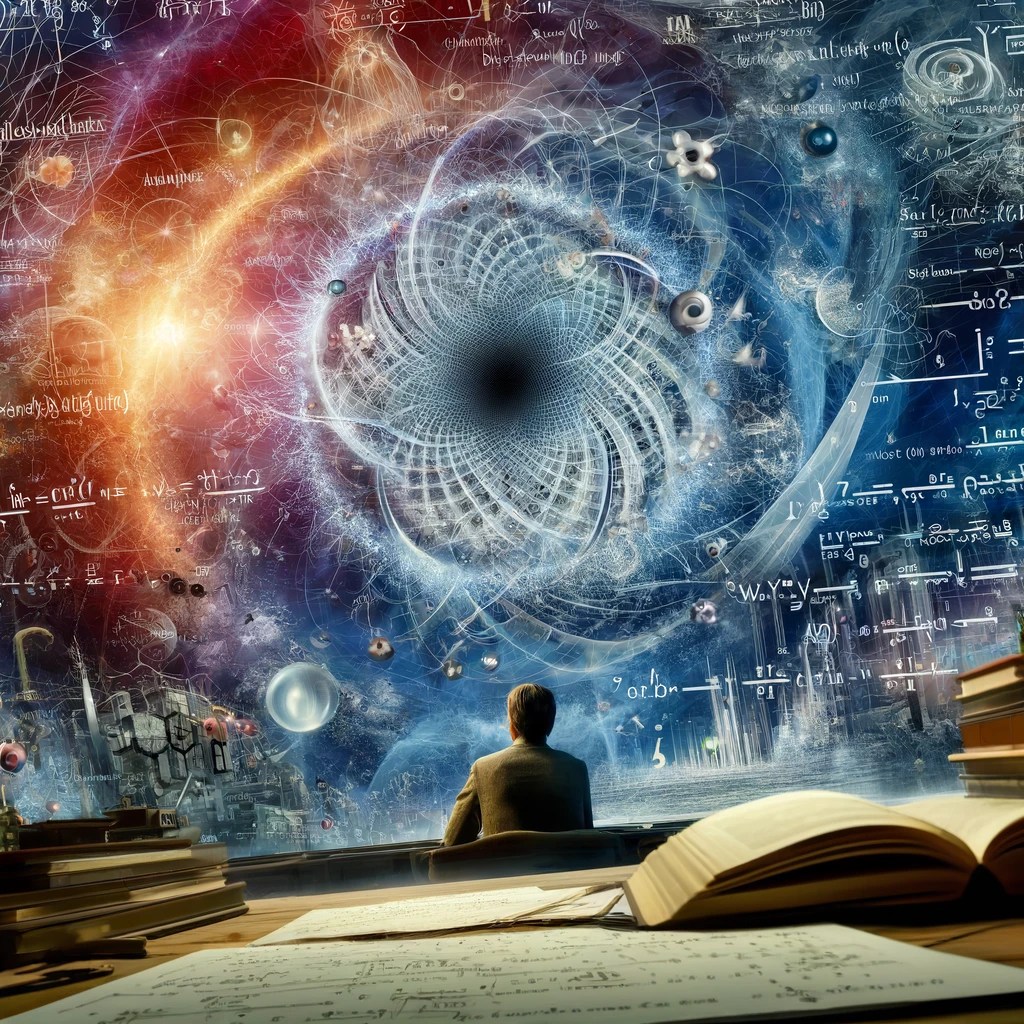
Quantum mechanics is the strange world where particles can be in multiple states at once, teleport across space, and influence each other instantly from light-years away. Imagine a place where observing something changes its reality, Schrödinger’s cat is both alive and dead, and every choice you make creates a new universe. Whether you’re a science fan or just curious about the universe’s mysteries, quantum mechanics offers a mind-bending look into how everything works.
When diving into the debate between Copenhagen and Many-Worlds (MW) interpretations of quantum mechanics, it’s clear that both offer fascinating insights into our universe.
The Copenhagen Interpretation, led by Niels Bohr, says a quantum system stays in superposition until observed, then collapses into a definite state. In contrast, Hugh Everett’s Many-Worlds Interpretation suggests that all possible outcomes of a quantum event happen in parallel universes. Each view reveals different aspects of the quantum world, challenging our understanding of reality.
The Copenhagen Interpretation, championed by Niels Bohr, while elegant in its simplicity, implies that the act of measurement plays a mysterious role in defining reality. It’s a bit like saying, “If a tree falls in a forest and no one is there to hear it, does it make a sound?” According to Copenhagen, the tree only falls once we observe it.
In contrast, the Many-Worlds Interpretation, suggests that all possible outcomes of a quantum event actually occur in branching, parallel universes. When you make a choice, the universe splits, creating a new world for each possible decision.
MW resonates because it doesn’t require an external observer to “collapse” a wave function. Instead, every action creates a branching reality. This isn’t just a theoretical fascination.The physicist Sean Carroll argued that MW could potentially explain why we haven’t observed any alien civilizations: our universe branched into one where we’re alone, while another version exists where alien life is abundant. Furthermore, the idea of parallel universes has permeated popular culture, inspiring movies like “Interstellar” and TV shows like “Rick and Morty,” which explore the implications of alternate realities and their impact on human experience.
Moreover, MW removes the observer’s paradox, making the universe’s behavior independent of human consciousness. This view aligns with a more egalitarian perspective, suggesting that our universe operates on principles that don’t cater to human perceptions alone.
Ultimately, while Copenhagen provides a more traditional, albeit mysterious framework, Many-Worlds offers a more expansive and exciting version of reality.


 unpublished alpha