While walking through a pristine cemetary at the base of a gigantic waterfall in Lauterbrunnen, Switzerland, all the headstones just had a name and date of birth and death.
No epitaths as I recently saw while visitng my uncle’s grave for his headstone unveiling (a Jewish tradition to look at gravestone 1 year after someone’s death).
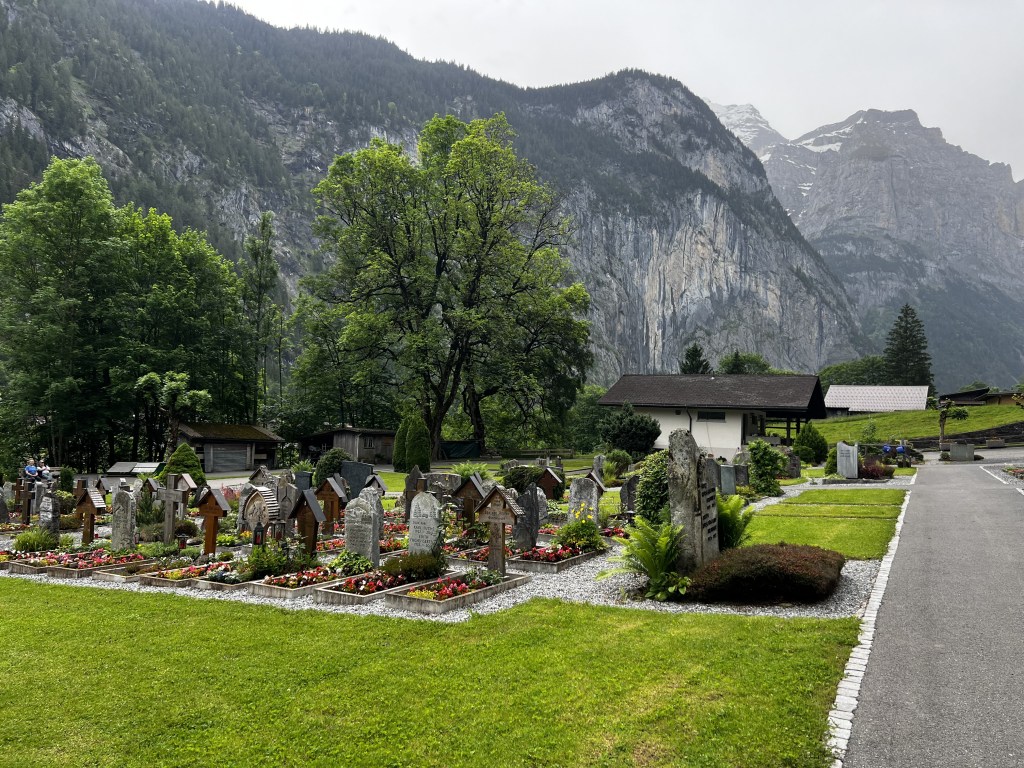
Graveyard in Lauterbrunnen
I took epitaphs for granted until last week, yet they have been part of human culture since 2600 BCE.
headstone history
Epitaphs were common in ancient Egypt, where tomb inscriptions detailed the lives and accomplishments of the deceased, often accompanied by prayers and offerings for the afterlife. The Greeks, about 2,000 years later, began using these inscriptions were often poetic and highlighted virtues, accomplishments, and relationships. Famous examples include epitaphs for fallen soldiers, such as those written by the poet Simonides.
Four thousand of us fought three million.
When you visit Sparta, tell them:
Here, the soldiers kept their word.-Simonides, Epitaph at Thermopylae
The Romans adopted and expanded upon Greek practices, inscribing epitaphs on tombstones and monuments. Roman epitaphs often included the deceased’s name, age, profession, and family information, along with brief phrases or sentiments about their life.
In medieval Europe, epitaphs continued to evolve with the spread of Christianity. They often included religious messages, prayers, and biblical quotes, reflecting the importance of faith and the hope for eternal life (kind of like what you see on a lot of people’s Instagram bios).
During the Renaissance, epitaphs became more elaborate and personalized. They often included detailed accounts of the deceased’s achievements, character, and family, along with artistic engravings.
Today, epitaphs remain a significant part of memorial practices across many cultures. They range from simple inscriptions of names and dates to more elaborate expressions of love, memory, and individual identity.
cultural differences
The most important part of someone’s life that we demarcate is their name and existence (years they were physically on earth). In Swiss culture, which values modesty and simplicity, this extends to grave markers. Understated memorials are preferred over elaborate epitaphs. However, practices can vary within Switzerland, influenced by local customs and traditions. Some regions may favor minimalistic gravestones due to specific local traditions.
In many Japanese cemeteries, gravestones typically include only the family name and sometimes the names of the deceased, emphasizing family heritage over individual accomplishments. Similarly, traditional Chinese graves often forgo lengthy epitaphs. They feature the names and dates of the deceased along with symbols or brief inscriptions reflecting cultural and familial respect.
Many Islamic traditions emphasize simplicity in burial. Gravestones often feature just the name of the deceased, date of death, and a short prayer or religious phrase, avoiding elaborate epitaphs. This practice reflects the Islamic focus on returning to Allah and viewing death as a transition rather than emphasizing the span of earthly life. Although the date of birth is less commonly included, some regions or families do include it alongside the date of death.
Sometimes, the date of death appears in specific calendars other than the commonly used Gregorian calendar. Fun fact: the Gregorian calendar, widely used in the Western world, was introduced by Pope Gregory XIII in 1582.
grave finances
Do you save money by not having an elaborate epitaph? Well, not really. It’s a not a Wheel-of-Fortune charge per vowel type situation, the expense is mostly related to the real estate and tombstone.
In many regions, you can now buy graves ahead of time, with specialized brokers assisting in the process. Brokers offer services such as identifying available plots, negotiating prices, and handling legal and administrative details. This professional assistance ensures that families find the most suitable resting place for their loved ones, considering location, cemetery regulations, and personal preferences. Don’t believe me? Just checkout https://www.lowcostgraves.com/
This is a far cry from the early 1900s where burial plots in the United States typically cost around $20 to $100. Adjusted for inflation, this would be approximately $500 to $2,500 today.
In 2014, a pair of burial plots located next to Marilyn Monroe’s in Westwood Village Memorial Park Cemetery, Los Angeles, were listed for $500,000 each.In 2009, a plot adjacent to Elvis Presley’s in Graceland Cemetery, Memphis, was offered for $300,000.The Golders Green Crematorium in London has some of the most expensive plots in the UK, with prices reaching up to £25,000 ($32,000 USD) for a prime location.
Currently, the average cost of a burial plot in the U.S. ranges from $1,500 to $4,000, depending on the location and the cemetery. In metropolitan areas, prices can exceed $10,000. Private cemeteries often charge more than public or church-owned cemeteries. Single, double, family plots, and mausoleum spaces all vary in price, with mausoleums typically being the most expensive. In some cases you can stack two coffins on top on one another instead of adjacent, which cuts the price by ~40%.
grave leasing
Grave leasing is a fascinating and pragmatic approach to addressing the ever-growing issue of cemetery space. While it may seem unusual to those accustomed to the idea of permanent graves, leasing burial plots is a common practice in many parts of the world.
In several European countries, leasing graves is a practical solution to limited cemetery space. This approach not only makes efficient use of available land but also ensures that cemeteries remain sustainable and well-maintained.
Switzerland is a prime example, where grave leases typically last 20-25 years. When the lease period ends, families have the option to renew. If they choose not to, the graves are “respectfully cleared,” and the plots are reused.
This means the remains are often moved to a communal ossuary, a container or room in which the bones of dead people are placed, freeing up the space for new burials.
This cyclical approach maintains the balance between honoring the deceased and accommodating future burials.
Germany offers grave leases of 15 to 30 years, with renewal options similar to Switzerland. France provides more varied leasing terms, including 10, 30, or 50 years, and even perpetual leases at higher costs. Spain follows with leases typically set at 10, 25, or 50 years. In Greece, due to space constraints, lease terms are shorter, ranging from 3 to 10 years, resulting in frequent clearing of graves and transferring remains to ossuaries or family tombs.
permanent approach
Contrastingly, countries like the United States and Canada predominantly offer permanent grave ownership. Here, graves are purchased outright, with no expiration date, and the plot remains in the family indefinitely. This practice stems from the ample land available and cultural expectations of a lasting resting place.
In the United Kingdom, the traditional model has been permanent ownership, though space constraints are prompting some cemeteries to offer lease options.
Australia also provides a mix of options. While perpetual ownership is common, some cemeteries now offer lease terms to address space issues.
Obviously depending on the lease options, many in Europe might be discouraged from investing in elaborate epitaphs.
Now, what happens if a cemetary doesn’t have funds to maintain the grounds? Many states require cemeteries to establish perpetual care funds (also known as endowment care funds). These funds are set aside specifically for the ongoing maintenance and care of the cemetery grounds. The amount deposited into these funds is often a percentage of the sale price of each burial plot. State laws typically regulate the management and use of these funds to ensure they are sufficient and properly used.
In addition to perpetual care funds, some cemeteries create trust funds to cover operational costs. These funds help ensure the cemetery remains financially solvent and can cover maintenance costs even if revenue from new plot sales declines. For pre-need sales (plots sold before the buyer’s death), the payment is often placed in an escrow account until the service is provided. This protects consumers and ensures funds are available when needed.
Plus, many cemeteries are municipally owned or operated by non-profit organizations. These entities are generally less susceptible to financial instability compared to private, for-profit cemeteries. Public ownership ensures that cemeteries remain operational and maintained regardless of financial challenges.
However, what happens when cemetaries close? We all know from watching horror movies like the Poltergeist, The Amityville Horror, or Pet Sematary, that building on a burial site is famously problematic. Yet, this doesn’t stop cities from repurposing these sites to parks, or in some cases residential or commercial buildings, and bodies are exhumed.
For instance, Lincoln Park in Chicago was once the Chicago City Cemetery, one of the largest in the mid-19th century. Maintenance issues, overcrowding, and public health concerns led to its closure and the relocation of many bodies to other cemeteries like Graceland Cemetery.
digital headstones
Outside of historical cemeteries and memorial sites, some of which are adopting digital headstones to provide visitors with rich, interactive historical information about notable figures and events, there are a few other countries adopting digital headstones.
Modern columbariums in Japan, which store urns of cremated remains, often incorporate digital displays to create personalized, interactive memorial experiences.
Some progressive cemeteries in Australia are adopting digital headstones to offer families a modern way to commemorate their loved ones. These headstones can display photos, videos, and biographical information.
No NFT headstones for now. Maybe someday, we’ll be paying respects in the metaverse with a virtual bouquet. But, hopefully not.

 unpublished alpha