Lakers welcome (podcaster) JJ Redick
The Lakers just hired JJ Redick, which is exciting for a team poised to make significant changes this offseason and build a championship contender 🤞. Yet, history is not on JJ’s side since despite flashes of brilliance and winning the in-season tournament, no head coach without NBA coaching experience (or podcaster turned coach) has won a championship in the past 30+ years. Additionally, at 39, JJ is a over a decade younger than the average age of championship-winning coaches since 1990, which is 52 years old.
The Lakers extended an offer to UConn’s head coach Dan Hurley, who led them to back-to-back national titles, but he declined the 6-year, $70 million offer. Success for college coaches transitioning to the NBA has been very limited. Larry Brown is the only exception in the past 20 years, but his success came after coaching in Philadelphia, not directly from Kansas.
NBA coach history
Since the NBA’s inception in 1946, over 350 men have served as head coaches (will Becky Hammon be the first female NBA coach?) Since 1990, a period more comparable to the modern era, about 200 coaches have held the head coach position, with the exact number varying due to mid-season changes and interim appointments. However, only 16 of these coaches have won an NBA championship (see table at the end of the post). Typically, and unsurprisingly, successful NBA coaches accumulate extensive experience, often starting as assistants or in other coaching roles before becoming head coaches.
the player turned coach: a case study
Jason Kidd is a notable player-turned-coach, highlighted by Dallas’ recent Finals appearance, but his coaching career has seen significant highs and notable challenges. Starting with the Brooklyn Nets in 2013, Kidd made an immediate impact by leading them to the playoffs. His tenure with the Milwaukee Bucks from 2014 to 2018 included a dramatic first-season improvement but was followed by mixed results and a mid-season firing.
As an assistant coach with the Los Angeles Lakers, Kidd contributed to their 2020 NBA championship. In his current role with the Dallas Mavericks, Kidd has experienced a deep playoff run, a disappointing 2022-2023 season, and a Finals appearance.
other players turned coaches
Looking further back, though less relevant to JJ, it’s notable from a basketball history perspective that other players have transitioned directly to head coaching without serving in interim roles. Bill Russell retired as a player in 1969 and became head coach of the Seattle SuperSonics in 1973, coaching them until 1977 and later the Sacramento Kings from 1987 to 1988. Similarly, Paul Silas went from player to head coach with the San Diego Clippers in 1980, right after retiring.
In the modern era, Magic Johnson retired as a player in 1991, briefly returned in 1996, and then became head coach of the Los Angeles Lakers the same year, finishing the 1993-1994 season with a 5-11 record (at least that’s better than Byron Scott’s worst-ever Lakers’ 23% winning percentage). Larry Bird also made this jump, retiring as a player in 1992 and becoming head coach of the Indiana Pacers in 1997, leading them to the NBA Finals in 2000.
Derek Fisher retired in 2014 and was immediately hired as head coach of the New York Knicks, where he had a 40-96 record over two seasons.
In 2020, the Nets weren’t afraid to hire another player turned rookie coach, Steven Nash. He coached the Brooklyn Nets from 2020 to 2022, compiling a 94-67 record. Despite his winning record, he isn’t remembered as a great head coach due to the high expectations following Kevin Durant’s arrival in 2020.
Steve Nash isn’t remembered as a great head coach while he coached the Brooklyn Nets from 2020-2022 despite amassing a 94-67 record. Mostly because Kevin Durant arrived in 2020, so expectations were quite high.
All successful player-coaches gained NBA coaching experience before winning a championship.
rookie coaches
Now that we’ve discussed player coaches, it’s also hard to be a first-time coach of a team and win a championship even with prior coaching experience. Only a few have done it, but it has been increasing in frequency: Paul Westhead (Los Angeles Lakers, 1980), Pat Riley (Los Angeles Lakers, 1982), Steve Kerr (Golden State Warriors, 2015), Tyronn Lue (Cleveland Cavaliers, 2016), Nick Nurse (Toronto Raptors, 2019).
the staff
The complexity of managing an NBA team has grown significantly over the years, particularly in terms of coaching staff. Today’s NBA head coaches oversee an expansive team of 7 to 8 assistant coaches, creating an unprecedented ~1:2 coach-to-player ratio. This stands in stark contrast to college basketball, where a 2023 rule change increased the cap from 3 to 5 assistants, and the 1990s NBA, which typically employed only 3 to 4 assistants. Some teams, like the Atlanta Hawks, have pushed this trend even further with 11 assistants.
This expansion reflects the increasing specialization and detailed approach required in modern professional basketball. Head coaches must now carefully curate their staff, ensuring a diverse range of expertise to enhance player development and team strategy. The quality of the entire coaching roster, not just the head coach, has become crucial to a team’s success.
The proliferation of specialized assistant coaches adds another layer of complexity to the already challenging transition from college to NBA coaching. Beyond adapting to differences in recruiting methods, season length, and gameplay dynamics, aspiring NBA head coaches must also learn to manage a larger, more diverse coaching staff effectively. This evolving landscape underscores the multifaceted nature of leadership required in today’s NBA.
the college coach transition to the NBA
Transitioning from college to the NBA has its success stories. Brad Stevens moved from Butler University to the Boston Celtics and quickly established himself as a capable NBA coach, known for his strategic acumen and player development skills. Larry Brown is a unique example of success at both levels, having won an NCAA championship with Kansas in 1988 and an NBA title with the Detroit Pistons in 2004.
However, the transition presents many challenges. Rick Pitino, despite his tremendous success in college basketball at the University of Kentucky, struggled in the NBA with the Boston Celtics, failing to replicate his collegiate achievements. Similarly, John Calipari, who coached at the University of Massachusetts (UMass) and later found success at the University of Kentucky, had a short-lived and unsuccessful NBA tenure with the New Jersey Nets. Both coaches found it difficult to translate their college coaching strategies to the professional level.
The transition from college to the NBA is challenging due to differences in the level of competition, the length of the season, and the nature of player management. Coaches who succeed, like Stevens and Brown, are often those who can adapt their strategies and effectively manage professional players.
growing up in the coaching system
Assistants who are promoted to head coaches often benefit from their deep familiarity with the organization and its players. Success in this archetype typically comes from understanding the team culture and having a clear strategic vision.
Gregg Popovich, one of the most successful head coaches in NBA history, exemplifies this path. He started as an assistant coach with the San Antonio Spurs under Larry Brown from 1988 to 1992 and then with the Golden State Warriors under Don Nelson from 1992 to 1994 before becoming the Spurs’ head coach in 1996. His deep understanding of the organization and ability to implement long-term strategies have been key to his success.
Erik Spoelstra also followed this trajectory, rising through the Miami Heat’s ranks from a video coordinator to head coach and winning multiple championships. His deep organizational knowledge and adaptability have been crucial.
However, not all transitions are smooth. Brian Shaw, despite being a highly regarded assistant with the Lakers, struggled in his head coaching role with the Denver Nuggets, highlighting the difficulties some assistants face when moving to the top job, which is no doubt a very difficult one.
a rarer transition: head coaches coming from another league?
While there are many athletes who compete in two professional leagues, the same is much rarer for coaches due to both the quantity and specialized nature of coaching positions. However, there are a couple exceptions. Eddie Stanky is the only multi-sport coach within basketball. He managed the St. Louis Cardinals in 1952-1953 while coaching the NBA’s Chicago Zephyrs in different seasons.
Joe Gibbs transitioned from successful NFL coaching (leading the Washington Redskins to three Super Bowl wins) to owning a dominant NASCAR team (winning 5 Cup Series Championships).
Lou Saban, Pat Shurmur, and Tommy Lasorda don’t directly qualify, but they both did move between sports executive positions. Lou moved between coaching football and working in leadership for a Major League Baseball team (New York Yankees president). Pat coached football and served as an assistant coach in the NBA. Tommy managed the Los Angeles Dodgers in the MLB from 1976 to 1996, but also had a brief stint scouting for the NFL’s Philadelphia Eagles.
strategic influence in gameplay
Successful NBA coaches define the strategic elements of the game. Historical figures like Red Auerbach, who led the Boston Celtics to nine championships, and modern coaches like Steve Kerr, who transformed the Golden State Warriors, showcase the impact of effective coaching.
Auerbach’s emphasis on team play and his pioneering use of the fast break offense set a lasting standard. Similarly, Phil Jackson, known as the “Zen Master,” brought the triangle offense to prominence, leading to a record 11 NBA championships with the Chicago Bulls and Los Angeles Lakers. These strategies not only secured championships but also reshaped the game.
Pat Riley, who coached the Showtime Lakers in the 1980s, implemented a fast-paced, high-scoring style that dominated the league. Gregg Popovich, with his focus on discipline, ball movement, and defense, turned the San Antonio Spurs into a model of consistency and success.
JJ Redick, despite his lack of formal coaching experience, brings a sharp basketball mind and a unique perspective through his podcast, where he analyzes the game and interviews players and coaches. His understanding of basketball strategy and player dynamics could make up for his lack of experience. Redick’s ability to communicate effectively and his modern approach, combined with assembling a knowledgeable coaching staff, could position him to follow in the footsteps of these legendary coaches.
Today’s NBA coach must be a manager, analyst, and tactician, navigating player personalities, media scrutiny, and relentless pressure to win.
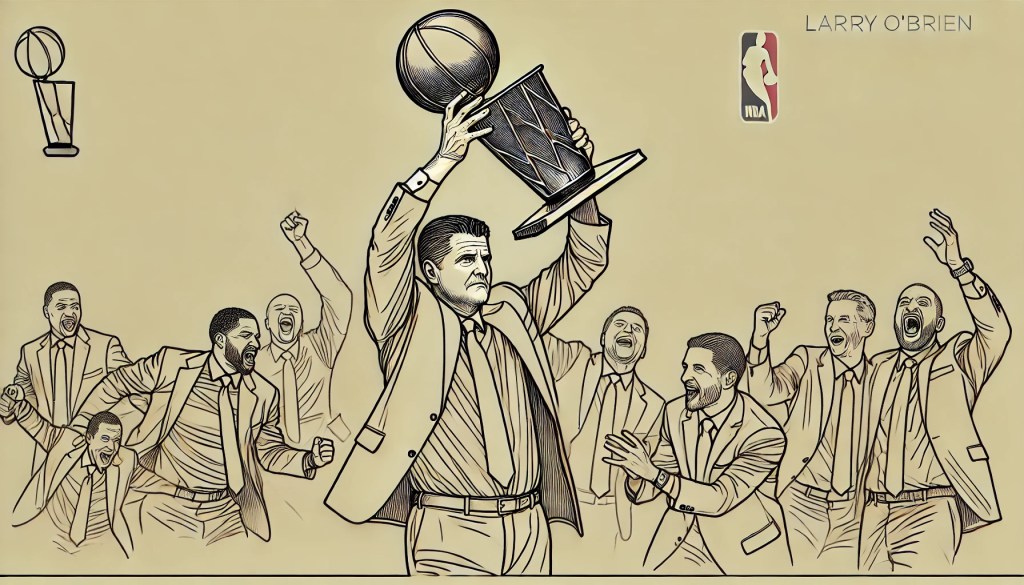
Laker Nation is holding its breath. JJ Redick’s arrival brings sharp shooting and veteran savvy, but in the land of purple and gold, only championship banners matter. The same rings true for the green-clad rivals in Boston. Redick’s got the skills, but does he have the killer instinct to push the Lakers over the top? The pressure’s on, the clock’s ticking. Will Redick be the missing piece in the Lakers’ championship puzzle and become the 8th Lakers head coach to win the Larry O’Brien Trophy, or will he join the 21 others who fell short in the quest for glory?
head coaches of championship teams
| year | coach | champion | prior role | aggregate NBA record |
| 1990 | Chuck Daly | Detroit Pistons | Assistant Coach, Detroit Pistons | 638-437 |
| 1991 | Phil Jackson | Chicago Bulls | Head Coach, Albany Patroons | 1155-485 |
| 1992 | Phil Jackson | Chicago Bulls | Head Coach, Chicago Bulls | 1155-485 |
| 1993 | Phil Jackson | Chicago Bulls | Head Coach, Chicago Bulls | 1155-485 |
| 1994 | Rudy Tomjanovich | Houston Rockets | Assistant Coach, Houston Rockets | 527-416 |
| 1995 | Rudy Tomjanovich | Houston Rockets | Head Coach, Houston Rockets | 527-416 |
| 1996 | Phil Jackson | Chicago Bulls | Head Coach, Chicago Bulls | 1155-485 |
| 1997 | Phil Jackson | Chicago Bulls | Head Coach, Chicago Bulls | 1155-485 |
| 1998 | Phil Jackson | Chicago Bulls | Head Coach, Chicago Bulls | 1155-485 |
| 1999 | Gregg Popovich | San Antonio Spurs | Assistant Coach, San Antonio Spurs | 1366-761 |
| 2000 | Phil Jackson | Los Angeles Lakers | Head Coach, Chicago Bulls | 1155-485 |
| 2001 | Phil Jackson | Los Angeles Lakers | Head Coach, Los Angeles Lakers | 1155-485 |
| 2002 | Phil Jackson | Los Angeles Lakers | Head Coach, Los Angeles Lakers | 1155-485 |
| 2003 | Gregg Popovich | San Antonio Spurs | Head Coach, San Antonio Spurs | 1366-761 |
| 2004 | Larry Brown | Detroit Pistons | Head Coach, Philadelphia 76ers | 1098-904 |
| 2005 | Gregg Popovich | San Antonio Spurs | Head Coach, San Antonio Spurs | 1366-761 |
| 2006 | Pat Riley | Miami Heat | Head Coach, New York Knicks | 1210-694 |
| 2007 | Gregg Popovich | San Antonio Spurs | Head Coach, San Antonio Spurs | 1366-761 |
| 2008 | Doc Rivers | Boston Celtics | Head Coach, Orlando Magic | 1043-735 |
| 2009 | Phil Jackson | Los Angeles Lakers | Head Coach, Chicago Bulls | 1155-485 |
| 2010 | Phil Jackson | Los Angeles Lakers | Head Coach, Los Angeles Lakers | 1155-485 |
| 2011 | Rick Carlisle | Dallas Mavericks | Assistant Coach, Indiana Pacers | 867-709 |
| 2012 | Erik Spoelstra | Miami Heat | Assistant Coach, Miami Heat | 704-424 |
| 2013 | Erik Spoelstra | Miami Heat | Head Coach, Miami Heat | 704-424 |
| 2014 | Gregg Popovich | San Antonio Spurs | Head Coach, San Antonio Spurs | 1366-761 |
| 2015 | Steve Kerr | Golden State Warriors | General Manager, Phoenix Suns | 473-200 |
| 2016 | Tyronn Lue | Cleveland Cavaliers | Assistant Coach, Los Angeles Clippers | 221-178 |
| 2017 | Steve Kerr | Golden State Warriors | Head Coach, Golden State Warriors | 473-200 |
| 2018 | Steve Kerr | Golden State Warriors | Head Coach, Golden State Warriors | 473-200 |
| 2019 | Nick Nurse | Toronto Raptors | Assistant Coach, Toronto Raptors | 227-163 |
| 2020 | Frank Vogel | Los Angeles Lakers | Head Coach, Indiana Pacers | 431-389 |
| 2021 | Mike Budenholzer | Milwaukee Bucks | Head Coach, Atlanta Hawks | 484-317 |
| 2022 | Steve Kerr | Golden State Warriors | Head Coach, Golden State Warriors | 473-200 |
| 2023 | Mike Malone | Denver Nuggets | Head Coach, Sacramento Kings | 299-236 |
- Joe currently holds the highest winning percentage among NBA coaches with over 150 games coached and is also the youngest head coach to win the NBA Finals since Bill Russell in 1969. ↩︎


 unpublished alpha