
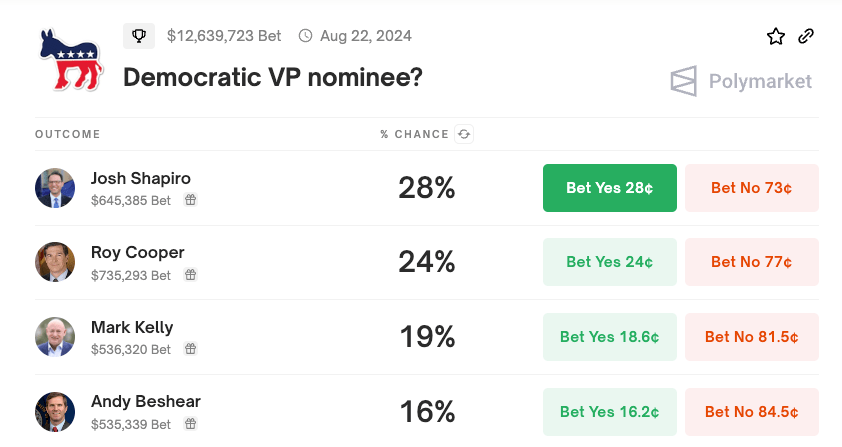
Stacey Abrams, Gretchen Whitmer, Pete Buttigieg, Tammy Duckworth, and Cory Booker all could be a VP pick for Kamala Harris, but they won’t be. According to Polymarket, either Josh Shapiro, Roy Cooper, Mark Kelly, or Andy Beshear have an 87% chance of winning at the time of writing (July 22, 2024 at 4:05pm). Polymarket thinks there’s an 89% chance the Democratic VP nominee will be a white man (up from 67% 3 days ago).
This is 1% shy of the current expected percentage for Kamala Harris securing the Democratic nomination.
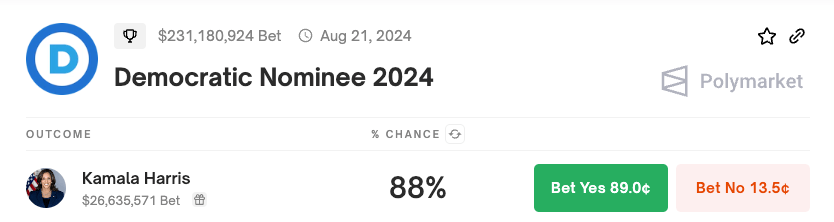
Although Biden’s dropout announcement is barely more than 24 hours old, making Harris, 22 years Biden’s junior, the nominee seems like an easy choice. He endorsed her along with a host of other politicians.
what’s the most strategic choice?
Let’s examine each candidate based on market predictions…
Josh Shapiro, Governor of Pennsylvania (19 electoral votes), offers a strong legal and governance background with significant appeal in the swing state of Pennsylvania (interestingly it held 2x the amount of electoral votes a century ago). Shapiro’s primary drawback is his relative newness to the national stage and limited federal experience. His efforts in consumer protection and criminal justice reform are commendable, but can he navigate the complexities of federal politics? Despite being a swing state, it has mostly voted deomcrat since the 1990s.

North Carolina Governor Roy Cooper (16 electoral votes, since it gained one after the 2020 census) brings extensive gubernatorial experience and a moderate stance that appeals to a broad electorate in another key battleground state, which Trump won in 2016 and 2020. However, he suffers from less national recognition and might not be as dynamic a speaker. Cooper’s healthcare and education reforms in North Carolina are notable, but his ability to captivate a national audience remains a question mark.
Senator Mark Kelly from Arizona (11 electoral votes) combines high name recognition with a compelling personal story and strong defense credentials. Despite his limited political experience, his influence in the swing state of Arizona, which recently flipped Democrat (Biden’s 49.4% support was the highest level for a Democratic candidate since 1964), is crucial. Kelly’s background as a former astronaut and military veteran provides a strong narrative, but his political inexperience could be a liability.
Andy Beshear, Governor of Kentucky (8 electoral votes), is notable for his bipartisan appeal and strong record on healthcare and economic development. However, Kentucky’s limited strategic electoral value, as it has voted Republican in the past six presidential elections, with Bill Clinton being the last Democrat to win the state in 1996, diminishes his appeal. Additionally, his lower national profile is a significant drawback. While Beshear’s success in a traditionally Republican state is impressive, the question remains whether it can translate to national appeal.
In this lineup, Shapiro and Kelly stand out due to their states’ pivotal electoral significance and recent political shifts, making them the most likely to win the VP nomination.
Now, let’s consider why Stacey Abrams, Gretchen Whitmer, Pete Buttigieg, Tammy Duckworth, and Cory Booker face significant challenges that make them less likely to be chosen as vice-presidential candidates.
Stacey Abrams (16 electoral votes), despite her high profile and strong voter mobilization efforts in Georgia, lacks executive experience and hails from a traditionally Republican state, which could limit her broader appeal. Abrams’ work in turning Georgia blue in the 2020 election is impressive, but her lack of executive experience is a significant drawback.
Michigan Governor Gretchen Whitmer (15 electoral votes), while experienced and noted for her strong leadership during the pandemic, is a polarizing figure, and the political landscape in Michigan remains unpredictable. Whitmer’s decisive actions during COVID-19 garnered praise and criticism, reflecting her polarizing status.
Pete Buttigieg (Indiana = 11 electoral votes), with his high name recognition and federal experience as Secretary of Transportation, has limited executive experience and concerns about his connectivity with a broader electorate. Buttigieg’s youth and fresh perspective are appealing, but his limited tenure as a mayor and federal experience raise questions about his readiness for a national role.
Senator Tammy Duckworth of Illinois (19 electoral votes) is a decorated veteran with a compelling personal story and strong defense credentials, but she represents a reliably blue state, which offers less strategic electoral value, and she has lower national recognition. Duckworth’s military service and personal resilience are admirable, but Illinois’ secure Democratic status diminishes her strategic advantage.
Finally, Senator Cory Booker from New Jersey (14 electoral votes) is a strong speaker with a high profile and appeals to African Americans, but New Jersey is a solidly blue state, and his past campaign missteps may hinder his viability. Booker’s eloquence and advocacy for social justice are noteworthy, but his past missteps and New Jersey’s electoral security are considerable hurdles.
Given these factors, these candidates are less likely to secure the VP nomination. My prediction is for the astronaut Mark Kelly. His unique background, combined with his state’s strategic importance, makes him a compelling choice for Kamala Harris’ running mate.
july 23rd update – mitt romney?
Some have mentioned Mitt Romney as a potential VP candidate, and Aaron Sorkin even published an op-ed last month suggesting the Democrats should pick Romney—a stance he has since retracted to support Kamala Harris. Currently, there’s no Polymarket market for Romney’s VP nomination, indicating his chances are less than 1%. However, let’s entertain the idea for a paragraph or two…
Choosing Romney would signal a commitment to bipartisanship and unity, addressing the current polarized political climate. This move could attract moderate voters from both parties who are frustrated with extreme partisanship. The message of unity and collaboration it sends might resonate with a substantial portion of the electorate, ultimately benefiting Harris’s campaign and governance strategy.
Additionally, Romney brings a wealth of experience, having served as a governor and a senator. His experience in governance and his reputation for integrity could complement Harris’s leadership, enhancing the administration’s overall credibility and attraviveness to independents. Plus, his calm and composed demeanor projects stability.
I see this as incredibly unlikely. First and foremost, Romney’s anti-abortion stance starkly contrasts with Harris’s views. Additionally, Romney will turn 80 in 2027 and doesn’t bring substantial electoral votes to the table. The deep ideological differences and partisan divisions would almost certainly provoke significant backlash from both parties’ bases.



 unpublished alpha