While views within the crypto and tech communities are far from uniform (as with any industry or subculture), there has been a notable shift in political alignments recently. A surge of Trump endorsements has emerged from a wide array of figures in the crypto and tech worlds, including both longtime supporters and new allies. Crypto personalities like Jesse Powell and the Winklevoss twins have made both donations and endorsements, alongside tech titans Marc Andreesen, Ben Horowitz, and Joe Lonsdale.
While Andreessen and Horowitz discuss Trump’s potential impact on tech, there are of course a crypto undertones. A few years ago they made $10B on Coinbase’s IPO and manage a a $7.6B crypto and web3 fund.
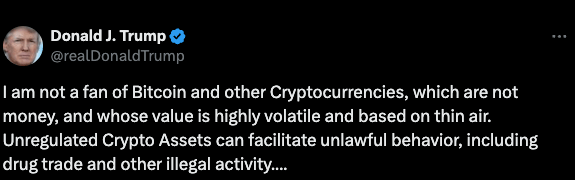
At a recent dinner with Trump, they discussed his views on AI, with Horowitz quoting Trump as saying, “AI is very scary, but we absolutely have to win because if we don’t win, China wins.” This statement, while not the most nuanced, aligns with a realpolitik approach, prioritizing strategic dominance over ethical considerations. I agree and don’t believe many Democrats entirely reject this view. Nevertheless, Trump’s deepening engagement with the crypto community, highlighted by his recent keynote speech at the Bitcoin 2024 Conference, underscores his evolving stance on digital currencies and signals a strategic pivot in his relationship with both the tech sector and the crypto space specifically. This marks an about-face from his 2021 remark where Trump called Bitcoin a scam (clip here). And from some of his earlier social media ramblings…
This shift prompted Vitalik Buterin’s excellent article, published a few week’s before Trump’s Bitcoin 2024 speech. Vitalik, Ethereum’s co-founder, advocates for a comprehensive, values-based approach to crypto policies. He cautions against a myopic focus on financial gains linked to token prices, urging the community to prioritize long-term principles over short-term political opportunism. Buterin’s stance emphasizes the importance of aligning crypto development and adoption with the foundational ethos of decentralization and individual empowerment that initially drove the movement.
If you see a politician being crypto-friendly, one thing you can do is look up their views on crypto itself five years ago. Similarly, look up their views on related topics such as encrypted messaging five years ago. Particularly, try to find a topic where “supporting freedom” is unaligned with “supporting corporations”; the copyright wars of the 2000s are a good example of this. This can be a good guide on what kinds of changes to their views might happen five years in the future.
-Vitalik Buterin
Although Vitalik doesn’t mention Trump by name in his article last month, early last week Michael Moritz, Sequoia’s co-founder, directly condemned the tech elite for supporting Trump.
Both he and Vitalik highlighted the importance of maintaining ethical integrity in the realms of cryptocurrency and technology. While their focuses differ, both emphasize the need for a principled approach that goes beyond short-term financial gains.
beyond pro-crypto politics
Buterin’s article challenges the crypto community to embrace a more holistic, values-driven approach to political engagement. He cautions against the simplistic strategy of backing politicians solely for their crypto-friendly policies, arguing that this narrow focus could ultimately undermine the fundamental principles that initially attracted people to the space.
He traces cryptocurrency’s roots to the cypherpunk movement, a techno-libertarian ideology that championed the use of technology to safeguard individual freedoms. He contends that the crypto community should broaden its focus beyond financial transactions, advocating for a comprehensive set of technological freedoms. These include privacy in communication, sovereignty over digital identity, and the protection of intellectual freedom.
“Crypto is not just cryptocurrency and blockchains,” Vitalik asserts. “What originally created crypto was the cypherpunk movement, a much broader techno-libertarian ethos which argued for free and open technology.”
hashing out democracy
While Buterin focuses on crypto policies, Moritz’s critique addresses Silicon Valley investors supporting political figures like Donald Trump. Moritz argues that these endorsements, often driven by financial interests, are short-sighted, potentially dangerous, and contradict these investors’ publicly stated values.
Moritz questions the ethical integrity of backing authoritarian figures for potential financial gains, stating, “They are, I suspect, seduced by the notion that because of their means, they will be able to control Trump.” He emphasizes the risks of compromising democratic principles for short-term benefits.
“Would they employ a convicted felon in their own businesses? Would they tolerate abuse and predatory behavior towards women in their offices?” Moritz asks, highlighting the ethical contradictions in such support.
I doubt whether any of them would want him as part of an investment syndicate that they organised. Why then do they dismiss his recent criminal conviction as nothing more than a politically inspired witch-hunt over a simple book-keeping error? Is it because they haven’t liked the tilt of the Federal Trade Commission since 2021 or do they believe that Trump will bolster the value of their bitcoin stakes? -Michael Moritz
This potential shift in focus towards bitcoin stakes at the expense of democracy has significant societal impacts, as Timothy Snyder reminds us that democracies do not persist automatically.
The European history of the twentieth century shows us that societies can break, democracies can fall, ethics can collapse, and ordinary men can find themselves standing over death pits with guns in their hands. -Timothy Snyder, On Tyranny
By supporting such leaders, investors risk endorsing policies that may ultimately undermine the very freedoms and/or decentralized principles they claim to support.
Albert Wenger, a partner at Union Square Ventures (USV), echoed Moritz’s concerns four days earlier. Like Andreessen Horowitz (a16z), USV reaped substantial rewards from Coinbase’s IPO, with their stake valued at $4.6B. This alignment of perspective from another beneficiary of crypto’s success adds weight to the critique.
It boggles the mind that a number of investors and entrepreneurs have come out in support of Trump despite his obviously disqualifying character, which has been revealed time and again through words and actions. Sometimes there are hard choices to make when people are immensely talented but also deeply flawed. This is not one of those situations. –Albert Wenger, Trump is Unfit to be President
vision vs. gains: shared concerns
Despite their different focuses, both Buterin and Moritz share concerns about prioritizing short-term financial gains over long-term ethical considerations. They argue for a more principled approach to decision-making.
Buterin warns against reducing the crypto vision to mere financial gains, stating, “The idea that freedom of payment specifically is the one that’s central to all other freedoms is something that came later – a cynic might say, it’s an ideology retroactively formed to justify ‘number go up’.”
Similarly, Moritz criticizes the notion that supporting controversial political figures can be justified by potential financial benefits. He argues that the long-term harm to societal values and democratic principles outweighs any short-term gains.
role of regulation
Both Buterin and Moritz acknowledge the role of regulation and in many cases it’s less than stellar implementation. Buterin points out that while some regulations are reasonable, there are fears of extreme measures that could harm the industry. He states, “there are fears that governments will attempt extreme steps like treating almost all coins as securities or banning self-hosted wallets.”
Moritz critiques the regulatory environment in California, arguing that it has driven companies and individuals out of the state. He notes, “the Trumpers aren’t alone in their frustration with California’s crippling regulatory regime, punishing tax code and sky-high home prices.”
integrating ethics and vision
While Vitalik and Moritz address different aspects of the tech world – Vitalik on the pitfalls of treating cryptocurrency as a single-issue political stance, and Moritz on the ethical implications of a Trump political endorsement – their arguments converge on a crucial point: the paramount importance of maintaining ethical integrity and embracing a long-term vision in decision-making.
As the tech industry continues to grow its influence on society, these perspectives offer valuable insights into the challenges of balancing innovation, financial interests, and ethical responsibilities. The conversation initiated by tech giants on both sides of the aisle underscores the need for first-principles thinking during this ongoing dialogue about the role of technology in shaping our political and economic future.