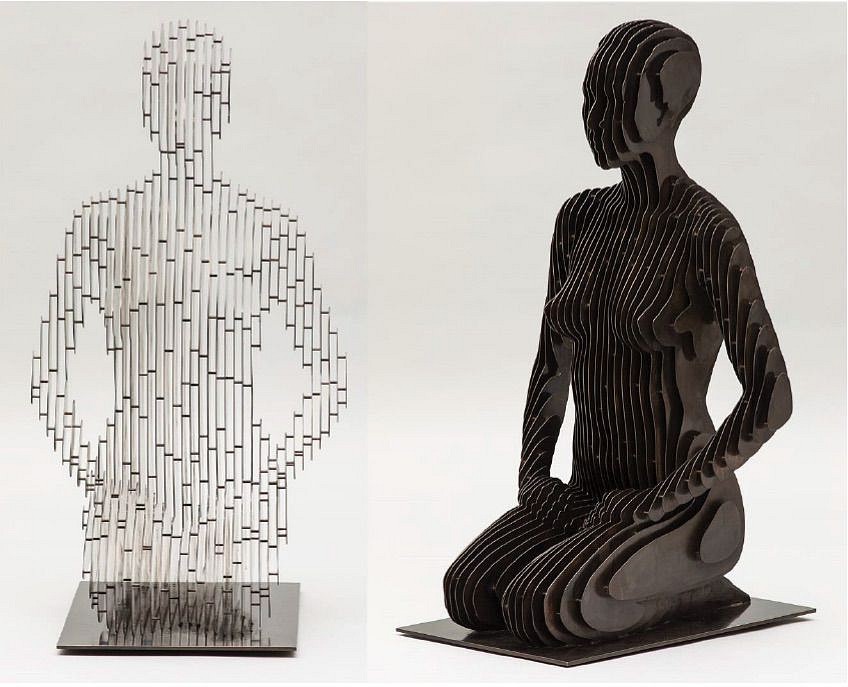
Julian Voss-Andreae may have started as an experimental physicist, but he’s best known for his sculptures, not his academic papers. His works vibrate with an understanding of the universe that only someone who has peered into its subatomic depths could manifest. Human figures in his sculptures seem to disintegrate and re-form in shifting light, speaking to both the fragility of perception and the nature of existence.
By welding together concepts from physics and art, Voss-Andreae transforms the invisible forces governing the world into tangible beauty, urging viewers to question not just what they see, but how they see.
His sculptures are inspired by the paradoxical nature of quantum physics. The double-slit experiment, where light and matter behave as both waves and particles, forms the foundation of his artistic exploration. Voss-Andreae often reflects on how large molecules, like the buckyballs he studied during his scientific research, can exhibit quantum behavior—traveling through two openings simultaneously and interfering with themselves.
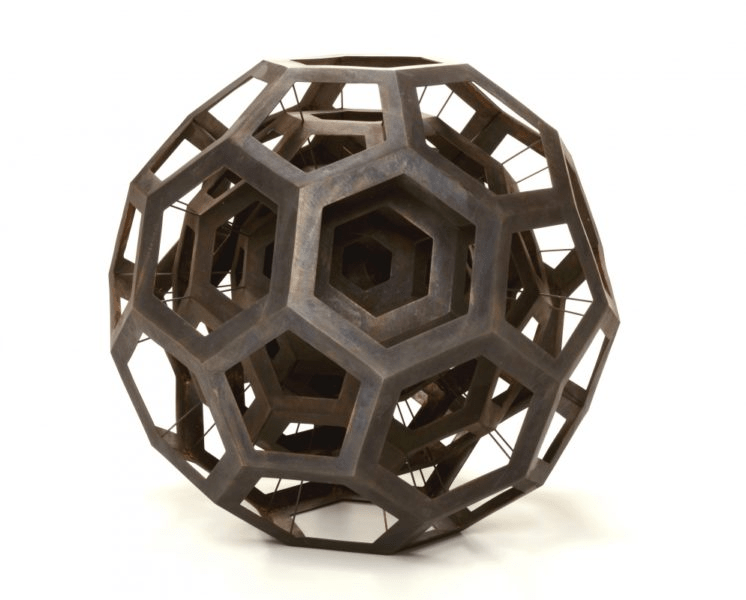
This elusive nature of reality is mirrored in his sculptures: steel and bronze figures that vanish and reappear depending on the viewer’s angle, capturing the fleeting and mysterious qualities of the quantum world.
Many of his public works play with the duality of light, making his sculptures both imposing and capable of vanishing. They embody presence and absence, challenging our assumptions about reality. The juxtaposition of solid forms with transient effects invites viewers to reconsider the world not as it seems but as it truly is: in constant motion, shaped by forces we barely comprehend. His sculptures become physical manifestations of the subatomic, embodying the idea that reality itself is fluid and perception is far from fixed.
Voss-Andreae’s shift from quantum physicist to sculptor wasn’t just a career change but the merging of two worlds he always saw as connected. “Physics and art both attempt to explain the mysteries of life,” he says. “I just chose a different medium to explore the questions I’ve always been fascinated by.”
the fragility of perception
In Voss-Andreae’s hands, materials like metal, glass, and wood become instruments of inquiry. His best-known work, Quantum Man, appears solid from one angle but dissolves into thin lines of steel as the viewer moves past.
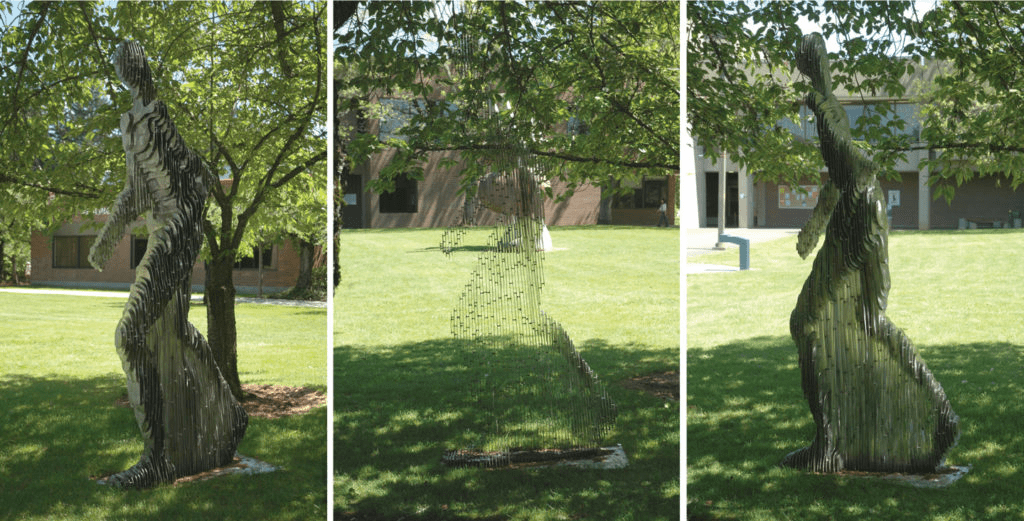
This tribute to the duality of particles and waves in quantum physics is also a meditation on the fragility of perception. The piece forces viewers to confront the transient nature of time, space, and identity. “Capturing the in-between,” as Voss-Andreae describes it, is where the tangible and intangible meet. His sculptures respond to light and movement, shifting and transforming before our eyes, much like the particles Voss-Andreae once studied under a microscope.
In Kneeling Man, along with many other of Andreae’s figures, a life-sized figure flickers between form and dissolution, suggesting that nothing is ever truly solid. Everything is in flux—not just at the molecular level, but in our lives. What appears stable is always subject to change.
Beyond their aesthetic appeal, Voss-Andreae’s works invite philosophical reflection. How much of what we “see” is real? How much does our mind fill in the gaps? In an era where technology blurs the lines of perception, his art resonates deeply. His pieces prompt viewers to confront the ambiguity of existence, asking: What if everything we think we know is only a fragment of the whole? We live in a constant state of flux.
the process
Voss-Andreae’s art is marked by mechanical precision. His sculptures, with their exacting execution, almost appear as if they’ve been printed directly from a 3D model. He uses a wide range of sculptural techniques, seamlessly merging traditional and modern processes. A key method is investment casting, where a wax model is encased in a ceramic shell. Once the shell hardens, the wax is melted away, and molten metal is poured in to form the final sculpture. This technique, which allows for intricate detail, is used in his more complex, geometric works.
In addition to investment casting, Voss-Andreae often employs laser cutting and computer numerical control (CNC) machining to precisely shape materials like stainless steel. These modern techniques enable the layered, dissolving forms seen in pieces like Quantum Man. Welding and grinding are also essential to his larger sculptures, allowing him to assemble life-sized or monumental figures with smooth edges and clean lines that accentuate the interaction between light and material.
His approach masterfully blends cutting-edge technology with hands-on craftsmanship. It transforms scientific concepts into visual forms, merging technical expertise with artistic vision.
langugage of geometry
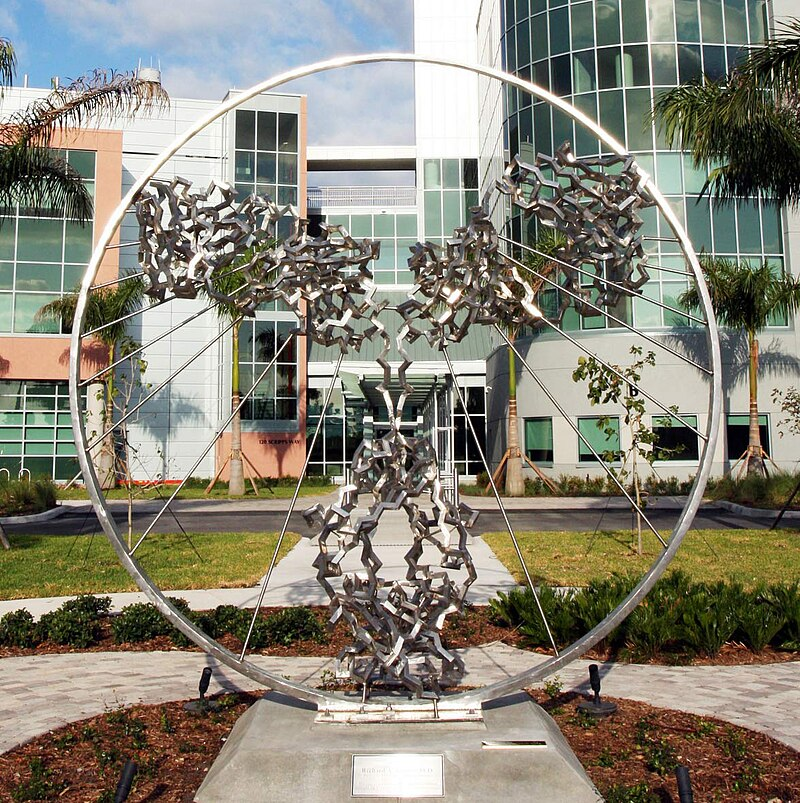
Voss-Andreae’s fascination with biomolecules, particularly proteins, deepens the intersection between mathematical precision and organic complexity. Proteins, the building blocks of life, offer him a bridge between the rigidity of physics and the fluidity of biology. His sculptures of alpha helices and human antibodies don’t just represent molecules aesthetically; they bring the invisible beauty of molecular biology into physical space. By rendering proteins like green fluorescent protein (GFP), a staple in neuroscience, Voss-Andreae emphasizes the tension between structure and fluidity, order and organic form. His work prompts reflection on life’s essential processes—hidden, yet crucial.
At the core of his sculptures lies a language of geometry. Shapes like tetrahedrons, dodecahedrons, and helices carry symbolic and scientific meaning. The tetrahedron, with its four triangular faces, mirrors the atomic structure of molecules like methane, suggesting that the universe’s complexity stems from simple building blocks. His use of the dodecahedron, with its twelve pentagonal faces, nods to Plato’s belief that this shape represented the hidden harmony of the cosmos, bridging ancient wisdom with modern science.
Helices, like those in DNA’s double-helix structure, wind through his work, symbolizing growth and evolution. These geometric forms transcend aesthetics, grounding his art in the invisible yet fundamental structures that govern existence. They remind us that what we see is only a fraction of reality.
moving beyond words to describe quantum phenomena
Voss-Andreae’s sculptures merge quantum physics, biology, and art, transforming scientific principles into tangible forms. His shift from science to art stemmed from a desire to communicate complex ideas visually, beyond words. His sculptures, like the antibody molecule with its outstretched “arms” mimicking the Vitruvian Man, invite viewers to contemplate the invisible forces shaping both our bodies and the universe.

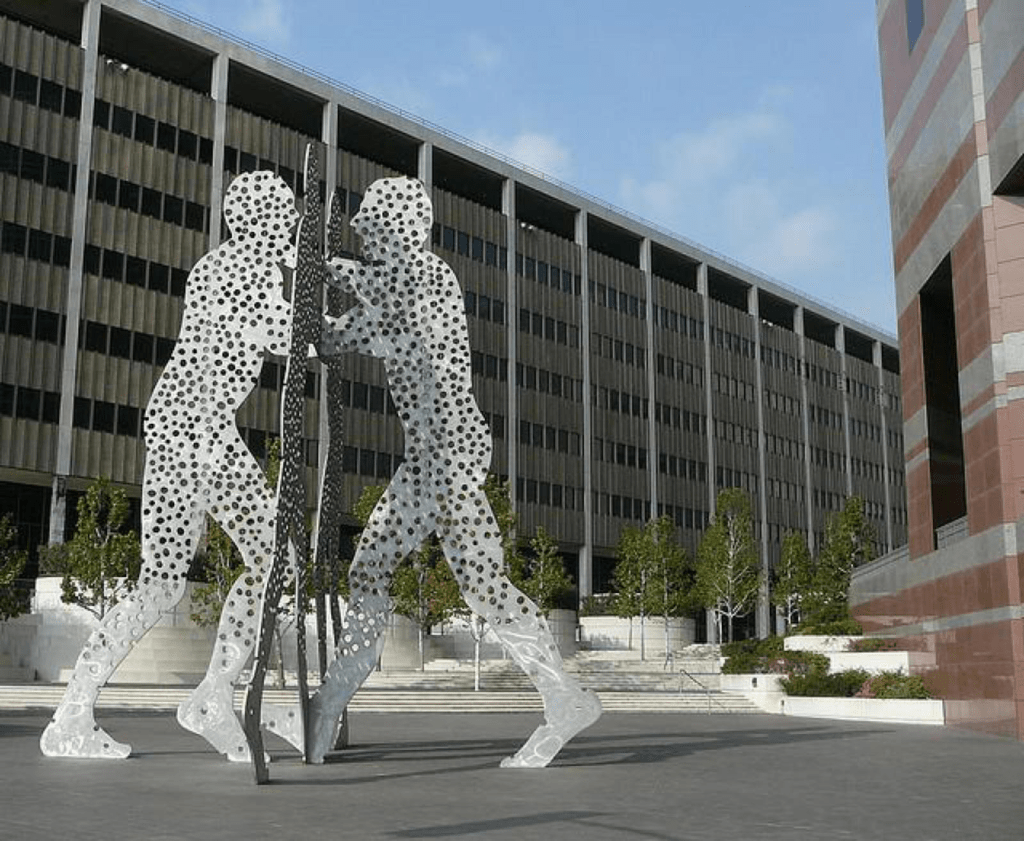
Voss-Andreae follows a legacy of artists fascinated by science who use kinetic sculpture to communicate ideas that transcend language. Jonathan Borofsky’s Molecule Man series, which debuted in Los Angeles in the late 1970s, exemplifies this approach. Borofsky’s human silhouettes, filled with holes, symbolize the molecules of humanity coming together to form existence.
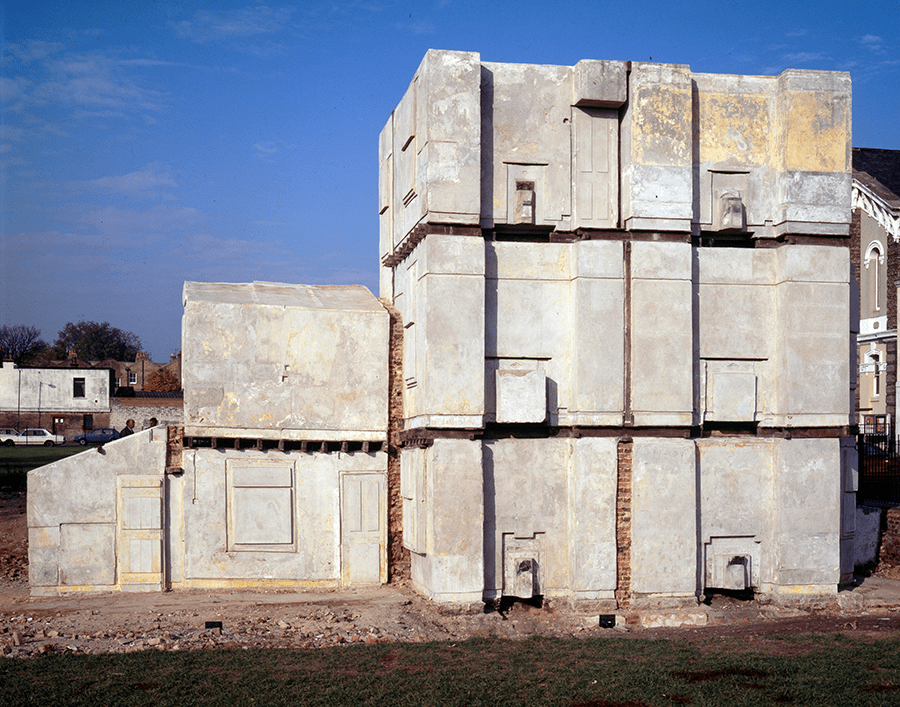
Voss-Andreae is often compared to artists like Antony Gormley, Rafael Lozano-Hemmer, and Rachel Whiteread. While Gormley explores the human form’s relationship with space, Voss-Andreae focuses on the quantum nature of reality. Whiteread’s House (1993), a concrete cast of a house’s interior, resonates with Voss-Andreae’s interest in absence and the unseen. Similarly, Yves Klein’s The Void (1958), which presented an empty gallery as art (the visual artist’s version of John Cage’s 4’33”) echos Voss-Andreae’s exploration of the unseen and the fluid boundaries between presence and absence and between negative space and perception.
These artists manipulate space and materiality to challenge viewers’ perceptions of solidity, time, and the physical world. Their shared focus on dynamic spatial relationships highlights the significance of the unseen. By engaging with the concept of absence, they reveal deeper truths about reality.
material ontology
Voss-Andreae’s work positions him as a material ontologist, deeply engaged with the interplay of presence and absence. His sculptures challenge viewers to navigate the tension between the seen and unseen, the material and immaterial.
His metal slat sculptures embody a post-materialist aesthetic, where figures dissolve into their surroundings, echoing Heisenberg’s uncertainty principle. While comparisons to Naum Gabo and Anish Kapoor arise, Voss-Andreae’s work differs by embedding an evolving, performative quality. His sculptures oscillate between visibility and invisibility, reframing the body as an emergent, fluctuating entity. The viewer’s perception shifts with each interaction, becoming part of the work itself.
His art embraces the concept of “emergent phenomena,” where complex behaviors arise from the interaction of simple elements. This emergence evolves through the viewer’s perception and the sculpture’s interaction with its environment. Light, movement, and perspective constantly reshape meaning, reinforcing that art is not static but a living process.
By dissolving the boundaries between art and science, Voss-Andreae redefines sculpture as an emergent, living entity. His work invites us to participate in the unfolding of reality, revealing that what we perceive as solid is, in truth, constantly in flux.

 unpublished alpha