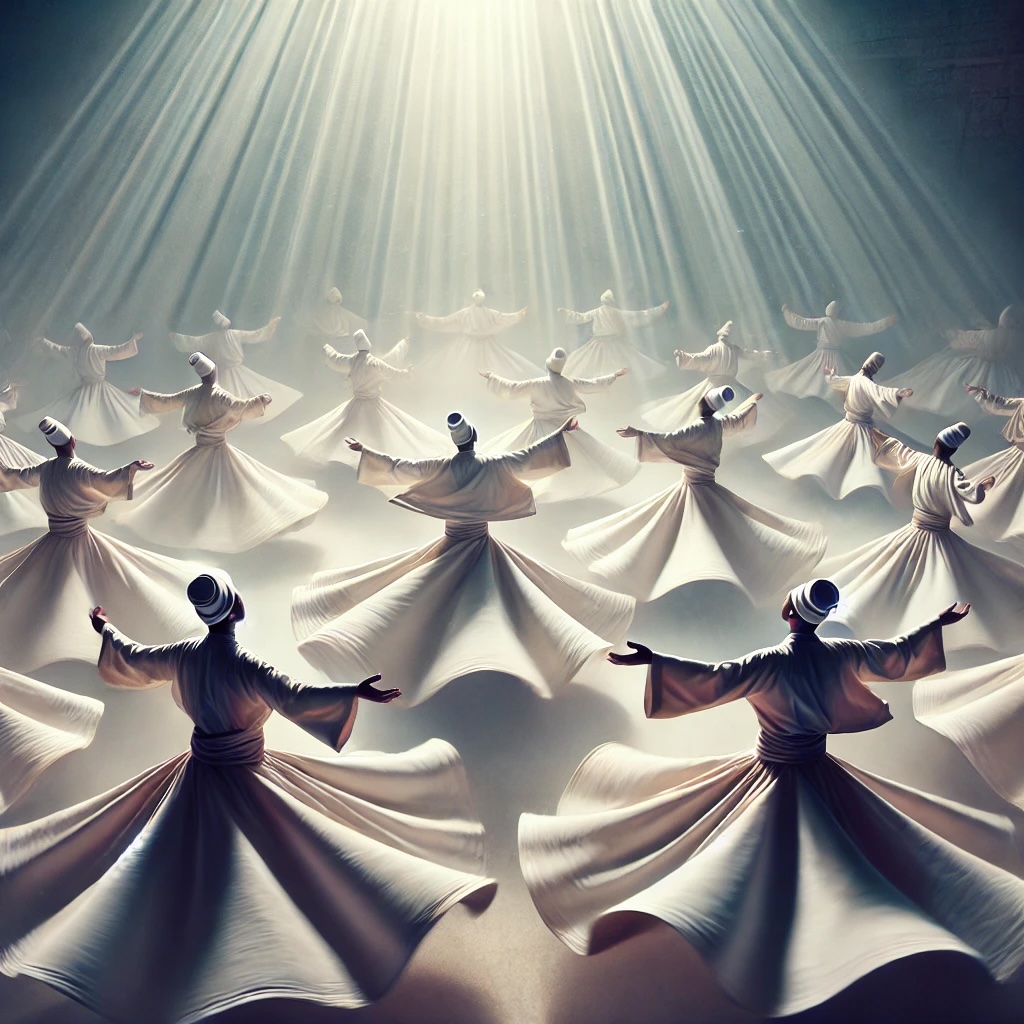
In Turkey, I sat in a quiet, dimly lit room, watching as a group of men in flowing white robes began to spin in slow, deliberate circles. The music was soft and repetitive, almost too soothing, and before long I found myself fighting off boredom rather than being mesmerized by the ancient ritual. But as I watched the dervishes twirl without losing their balance or focus, I couldn’t help but respect their discipline. What seemed so effortless—so meditative—was clearly the result of intense physical and mental preparation. Their ability to maintain such grace while spinning endlessly piqued my curiosity, and I began to wonder just how hard this practice really is.
The whirling dervish has long been an enduring image of spiritual devotion, spinning in slow, measured circles, seemingly disconnected from the physical world. The practice, known as Sema, traces its origins to the teachings of the 13th-century Sufi mystic, Rumi. It is often seen as a form of religious ceremony, a moving meditation. But the path to mastering this ancient art is far more demanding than the slow, graceful turns might suggest.
Once selected through a careful process within the Sufi community, based on their dedication to spiritual teachings and guidance from a sheikh, dervishes undergo intense physical training, spending hours perfecting balance and endurance to whirl without dizziness or fatigue. Under the sheikh’s supervision, they progress from basic spins to full participation in the Sema ritual, where continuous whirling for extended periods tests both their physical and spiritual mastery.
The whirling dervish is not the placid mystic one might imagine, but more like a “spiritual endurance athlete,” channeling strength and focus in what appears to be effortless grace. Spinning like a human gyroscope, their rotations are a kind of graceful death spiral toward the divine—pushing the limits of physical stamina and mental clarity. Despite the calm, the precision of their movement reveals the intensity beneath. It’s not just a meditation; it’s a physical feat requiring body and spirit to stay in perfect sync. In a world that never stops, maybe we all need to learn how to spin—how to find stillness in constant motion.
Training begins slowly, with controlled spins to help initiates stay grounded while strengthening their connection between mind and movement. Core strength, leg conditioning, and sustained focus are key. Over time, they progress to more intricate whirls, eventually reaching the trance-like state necessary for full ceremonies. The grace they display belies the physical discipline it takes to maintain that balance.
While the physical demands are undeniable, the spiritual dimension of the training cannot be overlooked. Sema is not just a performance; it’s a ritual intended to cultivate a connection to the divine. To become a whirling dervish is to engage in a profound journey of inner reflection, with the spinning designed to mirror the cosmic movement of the universe. The act of twirling isn’t merely mechanical; it’s a metaphor for the surrender of the self, for the ego dissolving as one spins closer to the divine. And no, this isn’t dizzy bat—it’s not about wobbling around in a haze but about finding clarity and balance through every rotation.
Music plays a crucial role in this ceremony. The haunting tones of the ney (reed flute) and the steady beat of the kudüm (drum) provide the rhythmic foundation for the dervishes’ movements. The dervish’s spinning is synchronized not to the music in a conventional sense, but to the deeper rhythm that the music evokes. The flow of sound and movement blend into a single experience, inviting the dervish into a meditative state that transcends the physical act of turning. For the audience, it is often a quiet and contemplative experience, but for the dervish, it is one of profound surrender and focus.
Yet, despite the deep spirituality of the practice, the contemporary landscape of whirling dervishes is complicated. Sufism, particularly in Turkey and parts of the Middle East, has faced periods of suppression, and this has impacted the tradition of whirling as well. Today, while many whirling dervishes still exist—most notably in Turkey, Iran, and the Balkans—their numbers are not as large as they once were. In some cases, the practice has been repurposed for tourists, reduced to a performance stripped of its deeper meaning. This commercialization contrasts sharply with the deeply spiritual roots of the tradition, where the act of whirling was a private, sacred ritual.
For those still practicing the traditional Sema, the ritual remains unchanged. Orders like the Mevlevi continue to pass down the practice from generation to generation. For them, Sema is a living connection to their faith and an embodiment of the teachings of Rumi. The act of spinning—moving from the body to the spirit, from the self to the divine—remains at the heart of their practice. It is their way of maintaining a direct line to an ancient tradition that seeks to answer the most fundamental questions of existence.
In thinking about the whirling dervish, it’s impossible not to draw parallels with other forms of art that blend physicality with deeper, often spiritual significance. The most obvious comparison might be to ballet, which, like the dervish’s spin, demands extraordinary control and grace. Yet where ballet is a performance, whirling is an act of devotion. Ballet tells a story; Sema seeks unity with the divine.
Another form that bears resemblance is Butoh, the post-war Japanese dance form. Butoh dancers explore deep emotional and spiritual themes through deliberate, slow movement, often using their bodies to access extreme states of consciousness. Like Sema, Butoh is concerned with transcending the self, moving beyond the limits of the body to connect with something larger, something indefinable.
Even Tai Chi, a martial art that emphasizes slow, circular movements, shares a surprising kinship with the whirling dervish. Tai Chi practitioners seek to balance internal energy, or qi, in a harmonious flow, a concept not far from the dervish’s pursuit of spiritual harmony through movement. Both art forms require a calm mind and a body that moves with precision and fluidity, turning motion into a meditative act.
But whirling is unique in that it doesn’t simply represent harmony; it is harmony. The dervish spins with one hand pointed to the heavens and the other to the earth, channeling the divine through their body. The spinning reflects the cosmic rotations of the planets, the turning of galaxies, and the cycles of life itself. In this way, the dervish embodies the movement of the universe, drawing the individual self into the greater whole.
This devotion to balance—between the body and spirit, the material and divine—sets the whirling dervishes apart. While other art forms may explore similar themes of surrender or transcendence, Sema is a direct embodiment of those ideas, enacted through movement alone. It is both an art and a prayer, a simultaneous offering and journey.
In a world that increasingly values speed and distraction, the whirling dervish offers a powerful contrast: a reminder that stillness can be found in movement, that the deepest truths are often found in simplicity. Through their spinning, they remind us that even in the act of turning, we can find a path to stillness—a path that transcends the physical and moves us closer to the divine.
As the dervish continues to whirl, the world around them fades. Their feet remain grounded, but their spirit spins freely, tethered to nothing but the rhythm of the universe itself.
 unpublished alpha