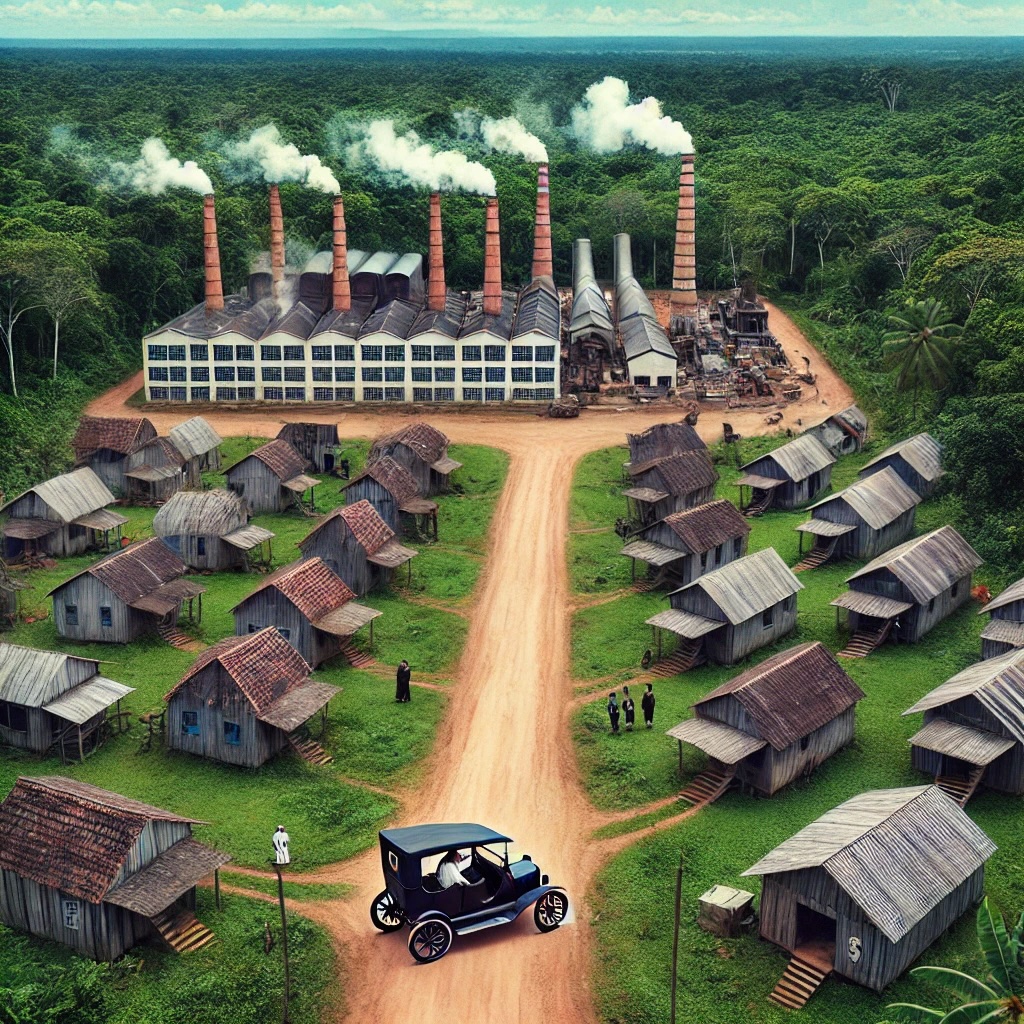
I went down the rabbit hole of factory towns and Fordlandia a few weeks ago and was struck by what seemed like a vestige of those times or the steelbelt are quite present today. Fordlandia was Henry Ford’s bizarrely ambitious, ill-fated attempt to transplant Midwestern industrialism into the Amazon, creating a rubber-fueled utopia that collapsed before it ever really look off, under the weight of cultural arrogance and ecological ignorance.
Although it’s more relevant today than Fordlandia ever was, Flint, Michigan, has had its own kind of collapse. During the mid-20th century, particularly in the 1950s and 1960s, it had one of the highest per-capita incomes in the United States. This period coincided with the height of GM’s dominance in the automotive industry, when Flint was a thriving industrial hub. At its peak, Flint was an economic powerhouse, with high wages for unionized autoworkers and a booming local economy. This prosperity began to decline in the late 1970s and 1980s as deindustrialization and GM’s plant closures took their toll on the city.
Flint is one of the most famous factory towns, but not the first. Yet despite the knowledge from history repeating itself, their success is always temporary. Whether it’s Lowell, Pullman, or Shenzhen, they thrive when the industry thrives. But no single industry dominates forever.
Sure some factory towns like Pittsburgh have made a resurgence. I’ve never been there and have few no one telling me I neeed to visit, but after the collapse of the steel industry, Pittsburgh reinvented itself as a hub for robotics and artificial intelligence, making it a post-industrial success story.
The first factory town in Pullman, Illinois, was built in the 1880s by George Pullman as a model community for his railway car workers. He controlled nearly every aspect of life—rents, stores, and social activities. It was efficient until it wasn’t. During the economic downturn of 1894, Pullman cut wages without lowering rents, leading to a violent strike supported by the American Railway Union. The strike paralyzed railroads nationwide, and federal troops were called in, resulting in bloodshed and a historic labor conflict.
Yet, new factory towns are making their way across the US. This is a bit counterintuative as the workforce is more mobile and global than ever. With the internet, people are hyper-aware of what’s possible and are more likely to crave anything but the stifling sameness of a factory town monoculture (I think). The world’s largest buildings remain sprawling offices and massive manufacturing plants, anchors that reshape communities and create towns rippling in their wake.
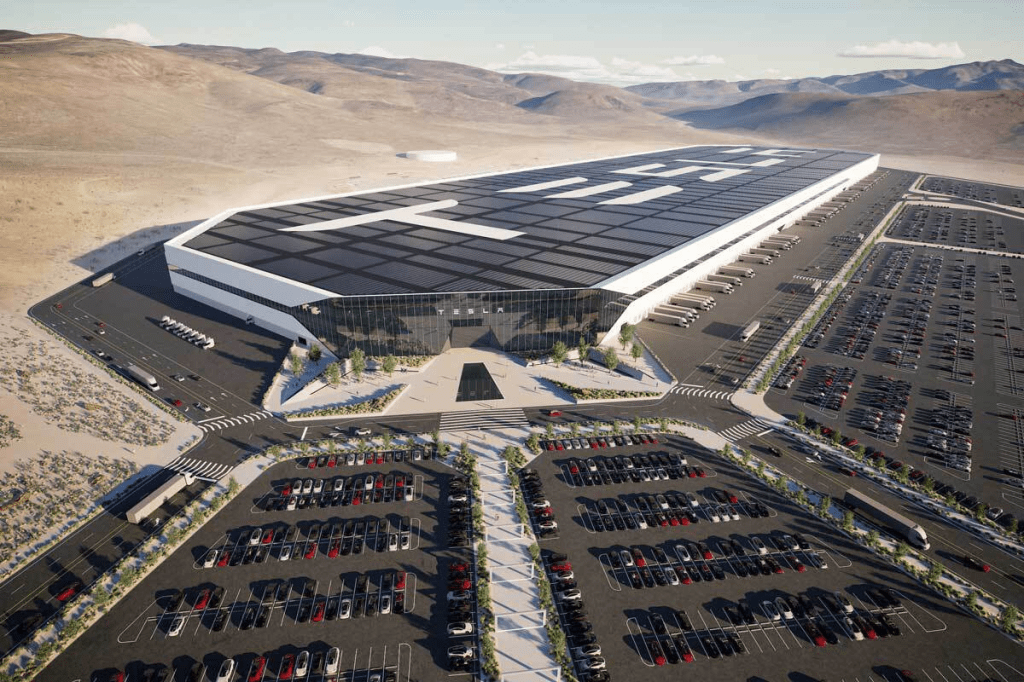
Covering 13.6 million square feet, Tesla’s Gigafactory in Sparks, Nevada, stands as the world’s largest building by footprint—a modern-day factory town anchor reshaping the local economy. Perhaps even more impactful is Tesla’s relocation from Los Angeles to Austin, a move that has sent housing prices soaring and reshaped the city’s economic and cultural landscape. Tesla’s move isn’t the only factor driving Austin’s transformation. The podcast boom and Texas’s zero state income tax are culprits. Another often overlooked factor is that it’s one of the few places where cowboy boots are socially acceptable and they’re a pretty fun thing to wear.
Economies of scale play a role, sure, but the game has become increasingly political. Amazon’s pageantry around its second headquarters bid and Apple’s 2.8-million-square-foot “spaceship” campus seem less about the practical need to centralize workers and more about leveraging political clout to secure favorable tax incentives. These massive developments also signal a growing desire to shape not just corporate culture but the broader lives of workers, consolidating influence far beyond the office walls.
Factory towns are fascinating urban planning experiments, but they often make the same mistakes; they’re built around short-term needs, not long-term growth. Look at Gary or Flint—those towns weren’t designed to evolve. Factory towns create a shared identity, but it’s fragile. When everyone’s livelihood depends on the same employer, the pressure to conform is immense. It’s not just an economic monoculture; it’s a social one. People lose the ability to imagine alternatives, which stifles innovation, diversity, and resilience.They are like single-threaded processes in computing. They’re incredibly efficient when the thread works perfectly, but one error can crash the system. From a systems design perspective, you’d want redundancy and parallel pathways—more industries, more employers, more backup plans.
This model might seem more tenable today because people can move and switch jobs with relative ease. It’s not about packing up the truck Joad-style to try your luck at farming; it’s hopping from one tech hub to another, landing a remote gig, or cashing in on Bitcoin early and retiring to spend 8 hours a day posting on Twitter.
Now the old factory towns that reduced everything to utility, or so I’ve heard since I’ve never been to one (if someone wants to write a rebuttal to this piece, I suggest they use this sentence to dessimate my agurment). They create places where every building, every street, every face seems in service to one goal. But human lives aren’t single-purpose. A town without space for the unexpected—for art, love, idleness—becomes a machine, and people can’t thrive in machines (ChatGPT wrote this past sentence. Kind of spooky.)
The real question is whether these neo-factory towns are engines of renewal or ticking time bombs, poised to wreak havoc on a modern landscape ill-equipped to absorb their fallout. Resident of Walmart’s Bentonville might argue its escaped the factory town moniker as it has evolved beyond its retail roots, experimenting with haute culture through museums and bike trails.
what we’ve seen before
Fast-forward to now. We’re watching factory towns reborn, shaped not by smokestacks but by solar arrays, electric vehicles, and cloud servers. Manufacturing jobs have increased by over 500,000 since 2010, much of that growth in the Rust Belt. The language surrounding these new hubs—terms like “innovation corridors” and “sustainable manufacturing zones”—may sound progressive, but the risks are alarmingly familiar, now with new twists. Take the documentary American Factory, where Fuyao Glass, a Chinese auto glass manufacturer, took over a shuttered GM plant in Dayton, Ohio. The acquisition revealed sharp cultural clashes between American workers and Chinese management. It’s a microcosm of China’s Belt and Road Initiative, which has brought significant cultural disruption to Africa and other regions in the name of short-term economic gain.
In Gary, Indiana, companies like U.S. Steel and Cleveland-Cliffs (formerly ArcelorMittal) are reinvesting in steel production, but without the jobs that once defined the industry. Advances in automation have significantly reduced labor needs, leaving the town grappling with whether these investments will lead to the economic renaissance they were promised or simply sustain production with minimal impact on local employment.
a city’s role as a shrine scaffold
Here’s the real conundrum: cities aren’t entirely innocent in this. Over-regulation, NIMBYism, and hostile tax policies often push corporations to the fringes—literally and metaphorically. Take Austin. The city’s housing crisis is partly a self-inflicted wound, the result of zoning laws that choke density. Tesla didn’t pick its outskirts for the view; it picked them because they were the only place willing to play ball. The same is true for SpaceX in Boca Chica, where Musk found pliable regulators but left local ecosystems gasping for breath.
Cities have to do better. If urban centers want to harness the energy of corporate investment without losing their souls, they need to stop shoving corporations to the edges and start coexisting. That means more housing, better infrastructure, and incentives tied not just to job creation but to community investment. Companies shouldn’t get to build empires in isolation.
So where does this leave us? Do we celebrate these new factory towns as the lifeboats of American manufacturing? Or do we critique their fragility, their monocultural risks, their tendency to leave communities high and dry when the tide turns?
The criticism is fair, but the inevitability of factory towns is harder to dispute. They’re back, and in their current iteration, they seem poised to stay. The efficiency, regulatory arbitrage, and monoculture that fuel their initial promise remain deeply embedded in the logic of capitalism. This mirrors Schumpeter’s concept of creative destruction—where capitalism thrives on cycles of renewal and obsolescence. Factory towns are less a question of whether they’ll persist and more about how they’ll evolve. My techno-optimist perspectve says yes, they can they become more antifragile, less prone to devastating bust cycles, and better equipped to adapt to the inevitable economic shifts.

 unpublished alpha