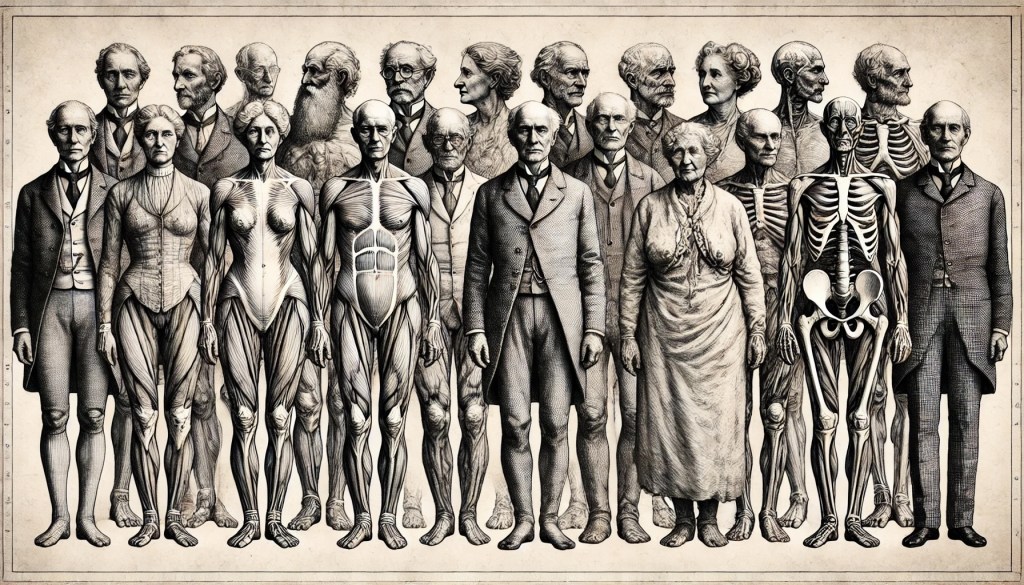
Did you know centenarians—once biological unicorns—have doubled in number every decade since the 1970s? Japan alone now boasts nearly 100,000 citizens who’ve passed the century mark. A staggering 17% of Japanese children born today are projected to reach 100, according to the National Institute of Population and Social Security Research. Meanwhile, Jeanne Calment reached 122 without ever downloading a health app, wearing an Apple watch or popping a senolytics pill.
But let’s be brutally honest: who wants to live to 105 if the last 25 years are spent watching Fox news from a nursing home bed?
increasing healthspan
This isn’t about surviving; it’s about thriving. It’s about 80-year-olds who still crush their step goals, 90-year-olds teaching university courses, and centenarians who can still remember where they put their keys.
For decades, the scientific establishment treated aging like taxes—inevitable, painful, and not worth fighting. But a new generation of researchers are asking: “What if entropy isn’t our destiny?”
Harvard’s David Sinclair puts it bluntly: “Aging is a disease, and diseases can be treated.” Meanwhile, venture capitalist Laura Deming is putting her money where the mitochondria are, funding companies that view aging as biology’s most exciting puzzle.
the senescent cell revolution
Ever wonder why we deteriorate? Partly because of “zombie cells”—senescent cells that refuse to die properly but hang around like that party guest who doesn’t realize it’s 2 a.m. They spew inflammatory compounds, damage neighboring cells, and generally cause metabolic mayhem.
Enter senolytics—compounds that selectively destroy these cellular party-crashers. In mouse studies, these interventions extended lifespan by 20-35%. If similar results translated to humans (admittedly a big “if”), we’d routinely see people reaching 100-115 years.
the architectural masterpiece
Longevity isn’t a single breakthrough; it’s an architectural marvel requiring each floor to support the next. So what’s the blueprint for our 2025 baby?
By 35: Metabolic health must be dialed in with laser precision. Can you imagine a world where your Apple Watch (or whatever replaces it) detects insulin resistance three years before your first pre-diabetic blood test? Where AI analyzes your breath compounds to detect early cardiovascular abnormalities? That world is nearly here.
By 50: Precision medicine needs to move from buzzword to baseline. Currently, 75% of cancer treatments work for only 25% of patients. What if your oncologist could sequence your tumor’s DNA in real-time and tailor treatment to its exact mutation profile? Companies like Grail and Freenome are racing to make early detection so precise that cancer becomes a chronic condition, not a death sentence.
By 70: Regenerative medicine must deliver on its promises. We’re already growing mini-organs in labs and 3D-printing tissues. At the Mayo Clinic, researchers have used senolytic drugs to improve physical function in patients with kidney disease by 12-15%. Small steps, perhaps, but revolutionary ones.
longevity escape velocity
Remember Ray Kurzweil? The futurist who puts away 50+ pills daily in his quest for immortality? He speaks of “longevity escape velocity”—the point where medical advances add more than one year of life expectancy per year of research.
Reach that threshold, and theoretically, you could surf the wave of innovation indefinitely. Kurzweil believes we’ll hit it by 2030—convenient timing for our hypothetical 2025 baby, wouldn’t you say?
this time might be different
“But wait,” I hear you protest, “hasn’t life expectancy in America actually decreased?” You’re right—it dropped from 78.8 years in 2019 to 76.4 in 2021, largely due to COVID-19, opioids, and chronic disease.
However, these statistics reflect population averages, not frontier possibilities. In 1903, most Americans had never seen an airplane; by 1969, we were walking on the moon. Progress happens unevenly, and then all at once.
Consider this: we’ve mapped the human genome, invented CRISPR gene editing, developed mRNA vaccines, and created AI that can predict protein structures. All within the last two decades. Does that sound like a civilization that’s hit its biological ceiling?
the human variable
Of course, none of this matters if our 2025 child grows up mainlining ultra-processed foods, gaming for 15 hours daily, and treating stress as a competitive sport.
A sobering reality check: only 3% of Americans currently meet all four basic health behaviors (not smoking (does zyn count?), maintaining healthy weight, eating five fruits/vegetables daily, and regular exercise). Another unsavory statistic is that 20% of meals in America are eaten in a car. Could technology shift these dismal numbers? Perhaps. Would mandatory “movement breaks” enforced by your smart home be dystopian or life-saving? A question for another essay.
the optimistic calculation
Despite these caveats, I’m placing my chips on the 105 hypothesis. The scientific tools are emerging faster than we can ethically debate them. The conversations have shifted from “Can we extend life?” to “Should we?” and “Who gets access?”
If you find this assessment too rosy, consider this: a human born in ancient Rome had a life expectancy of 25 years. A baby born in England in 1850 might reach 45. A child born in America today? About 77 years.
Who’s to say the curve stops here?
the ending we choose
Both my grandfathers died in their 70s, victims of heart disease and cancer—conditions we’re now learning to detect earlier and treat more effectively. Today’s children might view such “early” deaths the way we view 19th-century tuberculosis—tragic, but largely preventable.
The question isn’t whether humans can reach 105—they already do. The real question is whether reaching 105 can become ordinary rather than extraordinary. I believe it can, provided we build for structural longevity with the same determination that put humans on the moon.
After all, what could be more human than pushing against our limits? What could be more quintessentially us than looking death in the face and saying, “Not today”—and meaning it for another decade or two?



 unpublished alpha