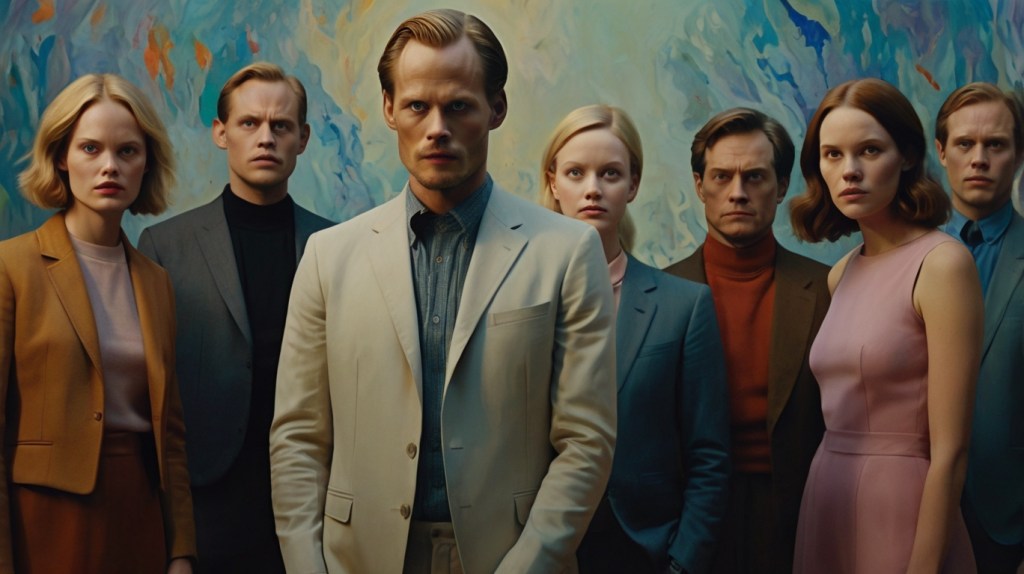
Sometimes you see acting dynasties and think, of course, nepotism. I grew up in Los Angeles (pronounced “elll-aeee”), so I know the drill: children of actors, musicians, directors, even agents find their way onto sets before they can vote. But the Skarsgårds feel like something stranger and more durable. It isn’t just that one child has carved out a career in the shadow of a famous father. It’s that several of them, all in overlapping generations, are not only relevant but distinct. And the father himself, Stellan Skarsgård, has never faded into irrelevance while his sons came up. Instead, he remains a force in cinema, still being cast in some of the biggest projects of the present, while Alexander, Bill, Gustaf, and Valter chart their own divergent paths. That simultaneity is wild, and it makes the Skarsgårds one of the more fascinating cases of artistic inheritance I can think of.
Stellan is the gravitational center. Born in Gothenburg, raised in a working-class Swedish family, he built his career slowly, earning attention first in Scandinavian film and theater before catching the eye of international directors. His breakout came with Lars von Trier’s Breaking the Waves in 1996, where his quiet, wounded performance set him apart as a European actor who could channel gravity without sliding into self-importance. After that came roles in Good Will Hunting (the math professor), Ronin, Chernobyl, and eventually the Dune films, where he plays the grotesque, floating Baron Harkonnen. There’s a quality to Stellan’s career that feels very twentieth-century: a slow accumulation of respect, a refusal to be pigeonholed, the ability to move from Bergman’s Swedish legacy to Hollywood prestige dramas to pulpy sci-fi without losing credibility. He reminds me of Donald Sutherland, or Max von Sydow. Both actors who could command seriousness but still take on blockbusters when the mood struck.
What I find interesting is the contrast between that kind of career and the ones his sons inherited. Alexander, the oldest of the acting Skarsgårds, first broke in through television. True Blood turned him into a symbol of supernatural charisma—a tall, glacial vampire who radiated Nordic allure. From there, he moved to films like Tarzan, where he trained himself into mythic musculature, and then The Northman, where Robert Eggers used him as a canvas for a Viking saga. At the same time, he pivoted into Big Little Lies, where his performance as an abusive husband earned him an Emmy. Alexander’s career feels less like Stellan’s slow burn and more like an ongoing negotiation with image: charisma, masculinity, danger. He has the presence to pull off myth, but he seems most alive when undercutting that myth with ambiguity or menace.
Bill, by contrast, achieved global recognition in one of the strangest ways possible: by burying his face under latex. His turn as Pennywise the Clown in It (2017 and 2019) made him a pop-culture icon, though few could recognize him on the street. There’s something telling about that. His father became known for performances where every wrinkle of his face spoke; Bill is most famous for erasing his face entirely, becoming a nightmare that dances at the edge of recognition. Beyond It, he’s taken darker, weirder roles—Hemlock Grove, Barbarian, John Wick: Chapter 4. Bill leans into unease. If Alexander is Nordic myth turned physical, Bill is Nordic eeriness turned grotesque.
Then there’s Gustaf, who doesn’t have the global name recognition of his brothers but built a strong niche through Vikings and Westworld. His roles tend toward the eccentric, the unsettling, the slightly mad. He feels like the brother most comfortable on the edge, less concerned with leading-man roles and more at ease embodying oddities and second-layer characters. And Valter, the youngest of the acting sons, has been carving out a space in Scandinavian film and television, suggesting the dynasty isn’t finished. Each son seems to have spun out a different thread of their father’s gravity; Alexander the mythic, Bill the grotesque, Gustaf the eccentric, Valter the indie.
That multiplicity raises the larger question: what does it mean to grow up in a house where acting is not dream but reality? Stellan and his wife My Skarsgård raised eight children, six of whom became actors (the other two became a physician and model). At some point, the line between family life and stage life blurs. Dinner conversations must have doubled as rehearsal, and the living room, one imagines, became its own theater. Nepotism alone doesn’t explain it. Yes, they had access. But plenty of acting children coast for a few years and fade. The Skarsgårds have somehow all found lanes that stick. That suggests an inheritance of more than opportunity—it suggests a shared seriousness, a kind of craft-mindedness that can’t be faked.
Dynasties are a recurring fascination in the arts. In America, we think of the Barrymores, a family that moved from stage to Hollywood excess. Or the Fondas, where Henry’s political gravitas gave way to Jane’s activism and Peter’s counterculture cool. The Coppolas are perhaps the most obvious parallel, with Francis Ford Coppola spawning a line that includes Sofia Coppola, Nicolas Cage (who shares my birthday), and Jason Schwartzman. What these dynasties reveal is a tension between inheritance and individuality. You inherit the name, the access, sometimes even the roles. But you also have to push against it, find your own space. The Skarsgårds fit this pattern, but with a Nordic twist: instead of rebellion, there’s differentiation. Each son channels something different, but none seem burdened by the name. Instead, they seem liberated by it, as if Stellan’s seriousness created a wide enough shadow to shelter them all.
Nordic-ness plays its own role. Scandinavian cinema has always carried an aura of gloom, myth, and weight, shaped by figures like Ingmar Bergman. Stellan grew up in that world; Alexander’s The Northman literally returns to it, staging the ancient sagas in brutal detail. Even Bill’s Pennywise, though American on paper, feels infused with something wintry and uncanny. The Skarsgårds seem to embody a certain Northern European sensibility: tall, pale, serious, willing to embrace darkness. They carry myth in their genes, or at least in their casting.
Yet what makes them fascinating is how their careers track the shift from twentieth-century acting to twenty-first-century celebrity. Stellan’s generation built reputations slowly, often through theater and art films, accumulating gravitas over decades. His sons were thrown into streaming fame and franchise spectacle almost instantly. True Blood, It, and Vikings are mass-market properties, with fandoms and memes built in. The Skarsgårds show the contrast between seriousness as craft and visibility as commodity. And yet, they’ve managed to balance both. Stellan can appear in Chernobyl while Bill terrifies audiences as Pennywise, and Alexander wins an Emmy in a prestige drama. The dynasty suggests that art and spectacle are no longer opposites. A family can hold both together.
Why do we fixate on dynasties in the first place? Maybe because they provide continuity in a culture of flux. Hollywood sells meritocracy, but dynasties remind us that celebrity replicates itself like aristocracy. At the same time, dynasties give us drama: will the child rise or fall, will they inherit or reject the crown? The Skarsgårds are fascinating because they seem to avoid the usual pitfalls. They are not tabloid fodder, not scandals, not burnouts. They are simply prolific, visible, working. The dynasty itself becomes a kind of reassurance: there will always be another Skarsgård, and he will probably be good.
In the end, what I admire about them is not just the roles but the way they embody art as inheritance. Stellan’s gravity didn’t trap his sons; it gave them room to explore different archetypes. Together, they stretch from myth to horror to prestige drama, from Hollywood spectacle to Scandinavian indie. They are not a single story but a constellation. For me, that constellation says something about what art and celebrity have become. Seriousness and spectacle now coexist, often uneasily, but sometimes, through the right family, harmoniously.
That’s why the Skarsgårds feel less like a case of nepotism and more like a parable. They show that inheritance, when handled with seriousness and range, doesn’t just replicate. It multiplies.



 unpublished alpha