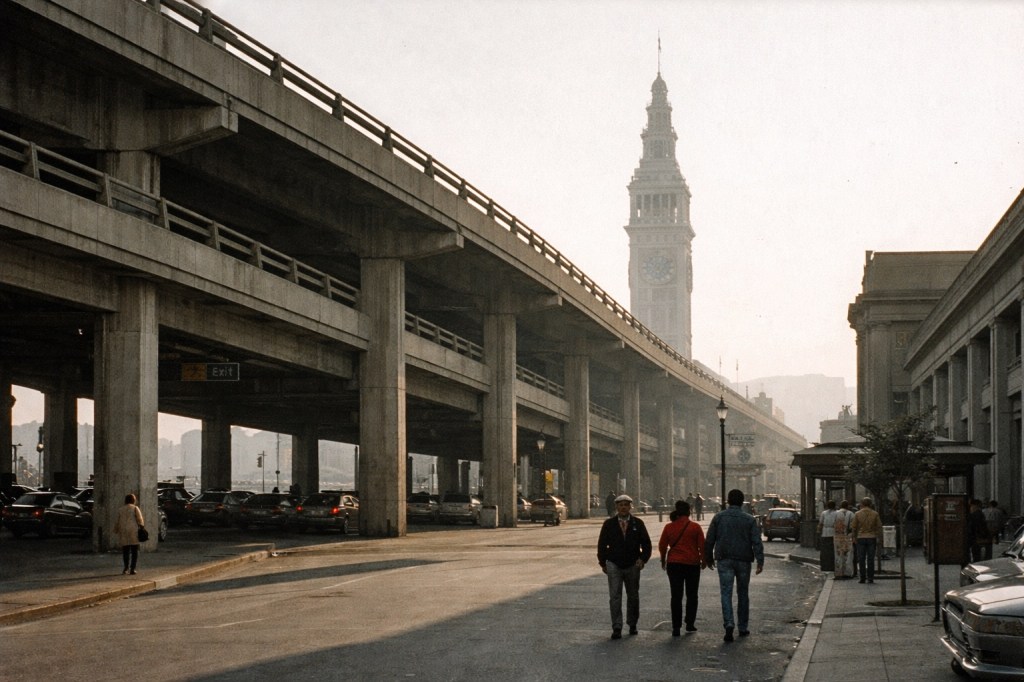
As someone born in the 1990s, I’ve never driven on the Embarcadero Freeway, which is inconvenient, because I’m about to argue that its failure says something important about how cities misunderstand themselves. I’m aware this is a weak opening credential. But the freeway matters less as a lived experience than as an idea, and ideas are often easier to interrogate after they’re gone.
The Embarcadero Freeway was built in the 1950s, when America believed speed was a moral good. It was elevated, double-decked, concrete, and unapologetic. Its purpose was simple: move cars quickly from the Bay Bridge into downtown San Francisco. It did that efficiently. It also severed the city from its waterfront, cast shadows over the Ferry Building, and made the bay feel like something you accessed only after navigating infrastructure designed to get you somewhere else.
From the beginning, people objected. They said the freeway was ugly. They said it was noisy. They said it blocked views. But these complaints existed inside a broader consensus that infrastructure equaled progress. If something made movement faster, it was justified. If something slowed movement, it was sentimental. Cities, in this worldview, were not destinations. They were conduits.
That belief held until October 1989, when the ground disrupted the argument. The Loma Prieta earthquake damaged the freeway beyond practical repair. Concrete cracked. Sections shifted. The structure was closed almost immediately. This is the moment when the story is usually framed as an engineering problem, but that’s misleading. The real question was psychological. San Francisco had to decide whether to rebuild something it had never fully embraced.
What happened next is why the freeway fascinates me. The city did not panic. Traffic did not implode. People adjusted their routes. They always do. The feared collapse of downtown mobility never quite materialized. And in that absence of disaster, a quieter realization emerged: maybe the freeway had not been essential after all.
The decision not to rebuild was presented as pragmatic, but it was also philosophical. Demolition began in 1991 and finished in 1992. The elevated road disappeared. In its place came a boulevard, a promenade, and eventually a waterfront that felt less like a compromise and more like a correction. The Ferry Building was restored. The bay became visible again. People lingered where they once passed through.
It’s tempting to call this a victory, but victories imply intention. This felt more like relief. Nobody held a collective press conference admitting the freeway had been a mistake (after all, it may not have been). The city simply allowed something to vanish and then noticed that life improved in its absence. That’s a rare form of accountability, because it requires no one to be wrong in public.
The freeway failed not because it collapsed, but because once it was gone, nobody wanted it back. That distinction matters. Plenty of structures are damaged and rebuilt. This one was damaged and then quietly disowned. It suggests that the freeway’s real failure was ideological. It represented a belief San Francisco no longer shared: that efficiency outweighed experience, that moving through a place mattered more than being in it.
This is where infrastructure becomes philosophy. Roads, bridges, and freeways are physical expressions of values. Once built, those values calcify. They become defaults. Removing them requires either catastrophe or consensus, and catastrophe is often the more effective catalyst because it absolves people of blame. The earthquake didn’t just damage concrete. It gave the city permission to reconsider an assumption.
But this is also where the story gets uncomfortable, because the erasure of infrastructure is not always benevolent. For every freeway that blocked something beautiful, there are structures whose removal damaged cities in quieter, more permanent ways. Highways across the United States destroyed neighborhoods that were economically vibrant and socially coherent. Those communities didn’t get promenades in return. They got displacement.
Natural disasters do similar work. Fires, floods, and earthquakes erase without discrimination. Sometimes they remove mistakes. Sometimes they remove things that were working. After the 1906 earthquake and fire, San Francisco was rebuilt grander and more orderly, but also less intimate. Social networks vanished. Density patterns changed. Progress arrived bundled with amnesia.
This complicates the Embarcadero narrative. It’s easy to celebrate the disappearance of something nobody loved. It’s harder to reckon with the things cities lose that nobody thought to defend. We tend to notice what obstructs us more than what sustains us. The freeway was visible in all the wrong ways. It blocked views. It announced itself constantly. The losses that hurt most are often invisible until they’re gone: affordable housing, walkable density, informal gathering places that don’t monetize attention.
The Embarcadero Freeway failed because it was incompatible with the city San Francisco eventually decided it wanted to be. But that decision was not inevitable. It required a moment when the cost of rebuilding exceeded the comfort of habit. It required a city wealthy enough, flexible enough, and confident enough to absorb uncertainty. Not every city gets that option.
What interests me most is how normal the absence now feels. Walking along the Embarcadero today, it’s hard to imagine an elevated freeway ever made sense there. The promenade feels obvious. The openness feels inevitable. That’s the final irony. The success of the removal erases the memory of how radical it once seemed.
Which raises the question I can’t shake: what structures do we currently accept as unavoidable, simply because we haven’t yet experienced the relief of their absence? Cities, like people, rarely abandon beliefs because they’ve been disproven. They abandon them when life makes them inconvenient to maintain.
The Embarcadero Freeway didn’t disappear because the city became visionary; it disappeared when San Francisco stopped mistaking speed for arrival and realized some ideas don’t need to be defeated (by humans) to be abandoned.

 unpublished alpha